

Summer Training
Following the completion of Advanced Camp at the end of their junior year (and occasionally prior to the Leadership Development and Assesment Course!) cadets are eligible to apply for selected Army training. This training is perfect for cadets who wish to experience the Army firsthand.
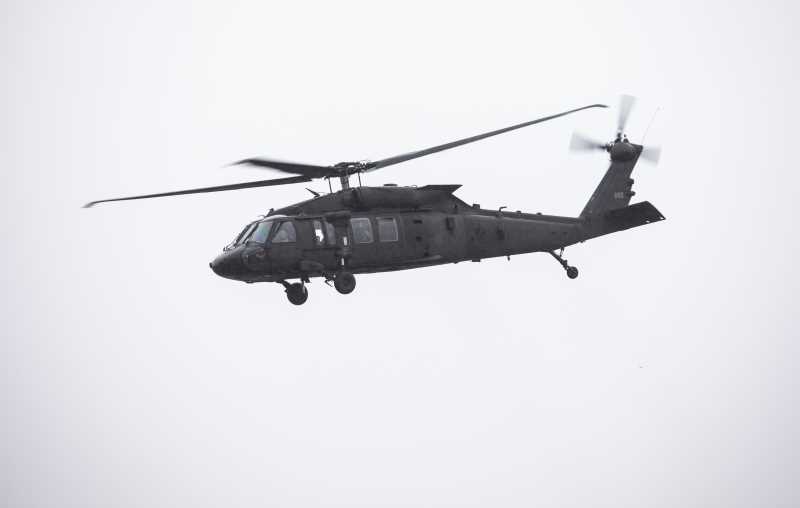
| AIRBORNE TRAINING: The US
Army Airborne School, located at Ft. Benning, Georgia, is
available to cadets that are enrolled in the program. The
course is three weeks long, consisting of a ground week,
tower week and jump week. With each week comes different
types of training designed to teach you to parachute from
airplanes and helicopters. It is an exciting non-stop course
that will push you to the limit. By graduation all students
will make five airplane jumps!
Congratulations to our 2009 graduates: CDT Bless, Fusilier, Pankonen, Schumer, and Wesley |
|
| AIR ASSAULT TRAINING: Air Assault training
is available at different Army posts across the country.
It is a 10 day course that consists of physical training,
sling load training, rappelling and a 12 mile road march.
This is a tough course that will exhaust you both physically
and mentally, but in the long run it will be worth every
ounce of energy you put into it! Congratulations to our 2009 graduates: CDT Wolfe and O'Brien |
![]() |
| NORTHERN WARFARE TRAINING: Northern Warfare
training will train you how to survive in the worst of conditions.
It also trains you in the art of moving and conducting missions
in all types of weather and on all types of terrain. This
course is not for the faint of heart; if you land a spot
at Northern Warfare School you'd better be prepared. |
|
| MOUNTAIN WARFARE TRAINING: Mountain Warfare School is a two-week course taught by the Vermont National Guard at Ethan Allen Firing Range in Jericho, Vermont. Both a summer and a winter phase are offered. The training is designed to make you an expert in mountain operations. Mountain Warfare School is both physically and mentally demanding. Training is non-stop, 15 hours per day, for 14 days. If you can carry a 65-pound rucksack up to five miles per day in mountainous terrain and are competent with both day and night land navigation you may have what it takes to complete this intense training |
|
| CADET TROOP LEADER TRAINING/Drill
Cadet Leadership Training (CTLT/DCLT): CTLT/DCLT
increases each cadet's leadership experience. Cadets are
assigned to a platoon leader position in a regular active
duty Army unit and given an opportunity to lead soldiers.
It provides cadets with first hand experience with the command,
training, administration, and logistical functions of active
duty units. It also exposes cadets to the on-duty and off-duty
environment of the junior officer. Congratulations to our 2009 graduates: CDTs Flancher, Hesse, Spychalla, Thomson, and Wolfe |
|
| Nurse Summer Training Program (NSTP):
NSTP is a clinical elective offered at Army hospitals in
the United
States and Germany. NSTP is a paid elective attended during
the summer
between your junior and senior years of college. It gives
you the
opportunity to develop both your leadership and nursing
skills. It will
introduce you to the Army Medical Department and the roles
and
responsibilities of an Army Nurse Corps officer. |
![]() |
| Army Medical Department Internship
Program (AMEDDIP): The Office of the Army Surgeon
General sponsors the program. Cadets are assigned to Medical
Department Activities (MEDDAC) and Medical Centers (MEDCEN).
The purpose of the AMEDDIP is to offer a cadet insight into
the Army Medical Facilities and exposure to leadership in
the medical arena. Cadets are assigned to a preceptor and
work under their direct supervision and direction of an
AMEDD officer. Congratulations to our 2009 graduates: CDTs Girolamo and Strobush |
![]() |
| Olmsted Cultural Immersion Program
(OCIP):
The program is to be considered as much a
broadening and leadership development opportunity as an
academic or scholastic opportunity. Travel must be to and in
a non-English speaking country with exposure to foreign
language, diverse cultural perspectives and a consideration
of the role of US policy in that country or region. For additional information: http://www.olmstedfoundation.org/olmsted/web/index.cfm?view=undergraduateProgram/vwContent&entID=68 Congratulations to our 2009 graduates: CDT Morris |
|
| Leader's Training Course (LTC):
The main focus of LTC is to develop your leadership skills
through exposure to interactive personal and group
experiences. You will also be introduced to the
soldierization experience, as you will learn many of the
basic soldier skills that set us apart from our civilian
colleagues. Army Drill Sergeants and cadre from universities
across the nation play key roles in your experience as they
lead you through your daily training routine. Your cadre
team will provide you daily feedback and counseling on your
successes and areas still needing improvement.
Through this experience, you will learn how and when to lead
others and the importance of teamwork in accomplishing a
common goal. More importantly you will be taught the values
and ethos of an Army officer and what is required to achieve
this distinction.
Congratulations to our 2009 graduates: CDT Wanta |
![]() |