

| Why Study
Microbiology?
Undergraduate
Program
Clinical
Laboratory Science
Graduate Program
Non-majors Courses
High School Scholars Camps
Microbiology
Scholarships
Faculty
and Staff Directory
Research in the
Department
Facilities and
Equipment
Microbiology
Club
Upcoming Events
Alumni Page
Job
Openings
American
Soc. for Microbiology
Related Microbiology Links
Search
Microbiology
Home Page
CSAH Home Page
|
Microbiology
Undergraduate Program - Major and Minor
Microbiology Major
Our curriculum is designed to
meet the recommendations of the American Society
for Microbiology and the American Academy of
Microbiologists. After completing introductory
courses in Biology and general Microbiology,
majors take a core of Microbiology courses
including Immunology, Microbial Genetics, and
Bacterial Physiology. Majors then choose from 16
elective offerings in diverse areas of
Microbiology. A particular strength of the
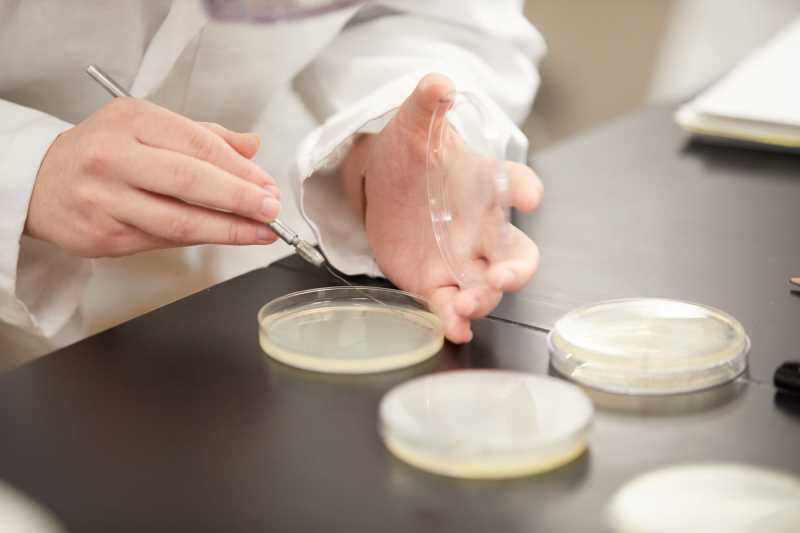
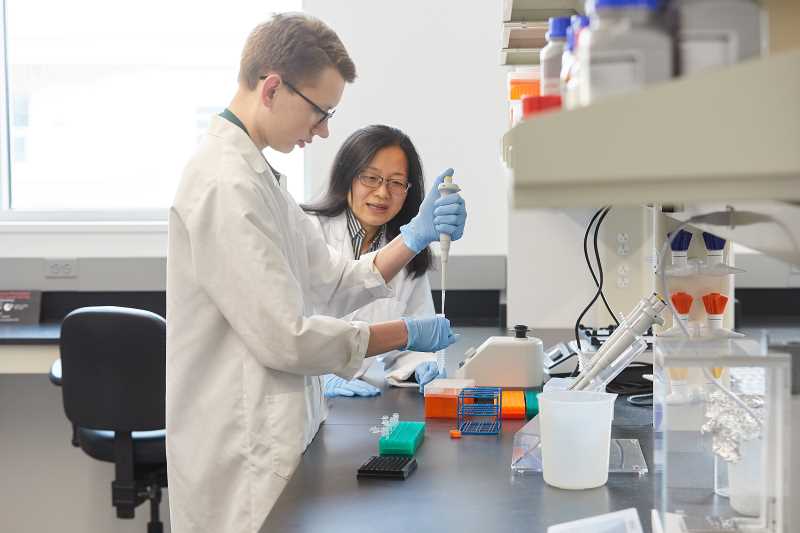
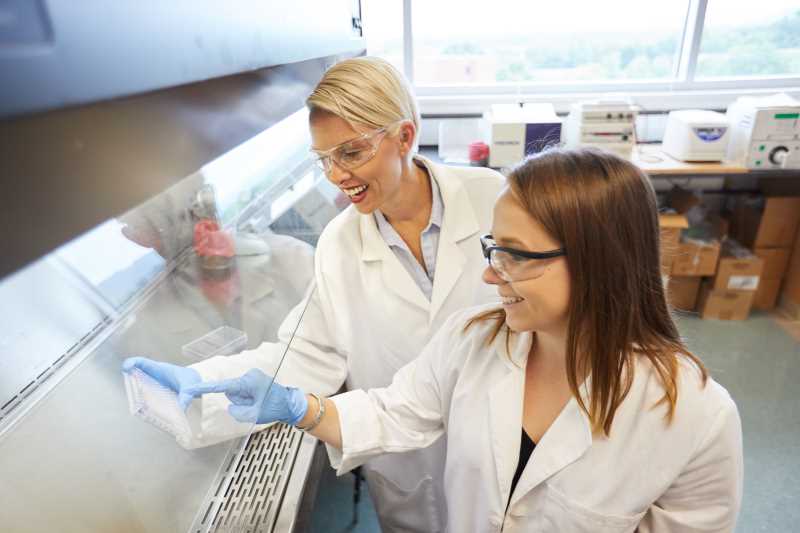
program lies with its emphasis on laboratory
competence. All core courses and the majority of
electives include laboratories that provide
students with extensive hands-on experience in
modern laboratory procedures in Microbiology.
Microbiology requirements are supplemented by
Chemistry and Biochemistry courses that can earn
students a minor in Chemistry. UW-La Crosse
Microbiology graduates have a minimum of 750
hours of laboratory instruction! In addition,
numerous opportunities for work experience are
provided by cooperative internships with local
industries, employment in the department or on
faculty research grants, and through
undergraduate research projects. Regardless of
the area majors choose to emphasize, the core
curriculum provides a broad, fundamental
background in the science.
There are four different
tracks a Microbiology major can take at UW-L -
either the general Microbiology major, a Microbiology
major with a biomedical concentration, Microbiology
major with an environmental science concentration or a Microbiology major with a business concentration.
The curriculum for all three is listed below
followed by a series of sample 4-year schedules
reflecting the different areas and career
options.
Microbiology can be a valuable minor for a number of biology and health-related majors. It can also be a useful minor for chemistry, biochemistry, and computer science majors. Check out the minor below and see how these courses fit with your career plans.
Microbiology Curriculum
Requirements 2007/2009 Catalogue
(Note: Requirements for
students who entered the program prior to 2007 may
have been different. Please consult your advisor.)
Microbiology
Major
A. Biology Core
| Course |
Credits |
| BIO 105 (General
Biology) |
4 |
| 2nd Biology course (BIO 203 - Organismal Biology, BIO
204 -Plant Biology, 210 - Animal Biology,
306 - Genetics, 312 - Human Anatomy &
Phys. I or 315 - Cell Biology) |
3 - 4 |
B. Microbiology Core
| Course |
Credits |
| MIC 230 (Fundamentals of
Microbiology) |
4 |
| MIC 350 (Bacterial
Diversity; spring, fall in odd years) |
3 |
| MIC 406 (Immunology) |
4 |
| MIC 416 (Microbial
Genetics; fall) |
5 |
| MIC 425 (Bacterial
Physiology; spring) |
5 |
| MIC 461 (Capstone in
Microbiology) |
1 |
| Total Biology and
Microbiology core: |
29 - 30 |
C. Microbiology/Biology
electives
(10 - 11 credits; at least 6 credits from List I, a
maximum of two credits from List III, One course from List II is strongly recommended):
List I:
| Course |
Credits |
| MIC 380 (Food
Microbiology) |
4 |
| MIC 407 (Pathogenic
Bacteriology) |
4 |
| MIC 420 (Virology) |
3 |
| MIC 421 (Virology
Laboratory) |
2 |
| MIC 427
(Industrial/Fermentation Microbiology) |
3 |
| MIC 428 (Fermentation
Microbiology Laboratory) |
2 |
| MIC 434 Aquatic
Microbial Ecology) |
3 |
| MIC 440 (Bioinformatics) |
2 |
| MIC 454 (Mechanisms of
Microbial Pathogenicity) |
2 |
| MIC 460 (Symposium in
Microbiology) |
1-3 |
List II:
| Course |
Credits |
| BIO 406 (Parasitology) |
4 |
| BIO 412 (Mycology) |
4 |
| BIO 413 (Medical
Mycology) |
3 |
| BIO 442 (Plant Microbe
Interactions) |
3 |
| BIO 449 (Advanced Microscopy and Image Analysis) |
3 |
| BIO 463 (Aquatic Animal
Health) |
3 |
List III:
| Course |
Credits |
| MIC 479 (Microbiology
Laboratory Assistant) |
1 |
| MIC 489 (Independent
Study in Microbiology) |
1-2 |
| MIC 499 (Independent
Research in Microbiology) |
1-2 |
| Total
Biology/Microbiology credits: |
40 |
D. Additional
Requirements
| Course |
Credits |
| One course in physics
(PHY 125 or 104 or 204) |
4 |
Minimum of four courses
in chemistry including:
CHM 103, 104, 300 (or
303, 304, and 305) 325 (or 417 and 418) |
19-24 |
Students applying for professional and/or graduate schools should take a full year of physics (PHY 103/104 or 203/204). Students electing a Chemistry
minor must take CHM 301 (Analytical Chemistry)
and have 26 total credits of chemistry. The minor
can be fulfilled by taking: the two-semester
Organic or Biochemistry courses, Instrumental
Chemistry [CHM 441], Environmental Chemsitry [CHM
412], or Chemistry Research [CHM 499].
| E. Additional
General Education Requirements: |
36 cr. |
| F. General
University Electives: |
16-21 cr. |
| |
|
| Total Graduation
Requirements: |
120 credits |
Schedule of elective
offerings:
Fall Semester:
Pathogenic Bacteriology, Virology Laboratory, Industrial and Fermentaion
Microbiology, Aquatic Microbial Ecology (even
years), Parasitology, Mycology, Advanced Microscopy
Spring Semester:
Pathogenic Bacteriology, Virology, Food Microbiology, Mechanisms of
Microbial Pathogenicity (odd years), Bioinformatics, Medical
Mycology, Aquatic Animal Health, Plant-microbe Interactions (even
years)
J Term or Summer:
Bioinformatics (J-Term), Fermentation Microbiology Laboratory (summer - odd years), Vector Borne Disease (summer - even years)
top of page
Microbiology
Major: Biomedical Concentration
A. Biology Core
| Course |
Credits |
| BIO 105 (General
Biology) |
4 |
| BIO 312/313 (Human
Anatomy and Physiology) |
8 |
B. Microbiology Core
| Course |
Credits |
| MIC 230 (Fundamentals of
Microbiology) |
4 |
| MIC 406 (Immunology) |
4 |
| MIC 407 (Pathogenic
Bacteriology) |
4 |
| MIC 416 (Microbial
Genetics; fall) |
5 |
| MIC 425 (Bacterial
Physiology; spring) |
5 |
| MIC 461 (Capstone in
Microbiology) |
1 |
| Total Biology and
Microbiology core: |
35 |
C. Microbiology/Biology
electives
(five credits; at least three credits from List
I, a maximum of two credits from List III):
List I:
| Course |
Credits |
| MIC 350 (Bacterial
Diversity) |
3 |
| MIC 380 (Food
Microbiology) |
4 |
| MIC 420 (Virology) |
3 |
| MIC 421 (Virology
Laboratory) |
2 |
| MIC 440 (Bioinformatics) |
2 |
| MIC 454 (Mechanisms of
Microbial Pathogenesis) |
2 |
List II:
| Course |
Credits |
| BIO 406 (Parasitology) |
4 |
| BIO 412 (Mycology) |
4 |
| BIO 413 (Medical
Mycology) |
3 |
| BIO 435 (Molecular
Biology) |
3 |
| MIC 455 (Methods in Vector-Borne Disease Research) |
3 |
| BIO 463 (Aquatic Animal
Health) |
3 |
List III:
| Course |
Credits |
| MIC 479 (Microbiology
Laboratory Assistant) |
1 |
| MIC 489 (Independent
Study in Microbiology) |
1-2 |
| MIC 499 (Independent
Research in Microbiology) |
1-2 |
| |
|
| Total
Biology/Microbiology credits: |
40 |
D. Additional
Requirements
| Course |
Credits |
| One course in math (MTH
145 or higher) |
3-5 |
| One course in physics
(PHY 125 or 104 or 204) |
4 |
| Minimum of four courses
in chemistry including: CHM 103, 104, 300
(or 303, 304, and 305)
325 (or 417 and 418) |
19-24 |
Students applying for professional and/or graduate schools should take a full year of physics (PHY 103/104 or 203/204). Students electing a Chemistry
minor must take CHM 301 (Analytical Chemistry)
and have 26 total credits of chemistry. Pre-professional (pre-med, pre-vet, etc.) and CLS studednts must take genetics (BIO 306).
| E. Additional
General Education Requirements: |
31-33 cr. |
| F. General
University Electives: |
11-18 cr. |
| |
|
| Total Graduation
Requirements: |
120 credits |
Schedule of elective
offerings:
Fall Semester:
Bacterial Diversity (odd years),
Virology Laboratory, Parasitology, Mycology,
Molecular Biology
Spring Semester:
Bacterial Diversity, Virology, Food Microbiology,
Mechanisms of Microbial Pathogenesis (odd years),
Bioinformatics, Medical Mycology, Aquatic Animal
Health
J Term or Summer:
Bioinformatics (J-Term), Vector Borne Disease (summer - even years)
top of page
Microbiology
Major: Environmental Science Concentration
A. Biology Core
| Course |
Credits |
| BIO 105 (General
Biology) |
4 |
| 2nd BIO course (BIO 203 - Organismal Biology, BIO 204
-Plant Biology, 210 - Animal Biology) |
3-4 |
B. Microbiology Core
| Course |
Credits |
| MIC 230 (Fundamentals of
Microbiology) |
4 |
| MIC 350 (Bacterial
Diversity; every spring, fall in odd
years) |
3 |
| MIC 416 (Microbial
Genetics; fall) |
5 |
| MIC 425 (Bacterial
Physiology; spring) |
5 |
| MIC 434 (Aquatic
Microbial Ecology; fall
in even years) |
3 |
| MIC 461 (Capstone in
Microbiology) |
1 |
| Total Biology and
Microbiology core: |
28-29 |
C. Microbiology/Biology
electives
(11-12 credits; at least five credits from List I,
at least three credits from List II, and a
maximum of two credits from List III):
List I:
| Course |
Credits |
| MIC 406 (Immunology) |
4 |
| MIC 407 (Pathogenic
Bacteriology) |
4 |
| MIC 420 (Virology) |
3 |
| MIC 421 (Virology
Laboratory) |
2 |
| MIC 427
(Industrial/Fermentation Microbiology) |
3 |
| MIC 428 (Fermentation
Microbiology Laboratory) |
2 |
| MIC 440 (Bioinformatics) |
2 |
BIO 307 (Ecology) or
BIO 341 (Limnology) or
BIO 464 (Stream and Watershed Ecology) |
3 |
| BIO 441 (Environmental Toxicology) |
3 |
| BIO 447 (Standard
Methods of Water Analysis) |
3 |
| BIO 449 (Advanced Microscopy and Image Analysis) |
3 |
List II:
| Course |
Credits |
| BIO 406 (Parasitology) |
4 |
| BIO 412 (Mycology) |
4 |
| MIC 442 (Plant-Microbe
Interactions) |
3 |
| MIC 455 (Methods in Vector-Borne Disease Research) |
3 |
| BIO 463 (Aquatic Animal
Health) |
3 |
List III:
| Course |
Credits |
| MIC 479 (Microbiology
Laboratory Assistant) |
1 |
| MIC 489 (Independent
Study in Microbiology) |
1-2 |
| MIC 499 (Independent
Research in Microbiology) |
1-2 |
| |
|
| Total
Biology/Microbiology credits: |
40 |
D. Additional
Requirements
| Course |
Credits |
| MTH 145 or 250 and 175 or
207 |
8-9 |
| One course in physics
(PHY 125 or
104 or 204) |
4 |
| Minimum of five courses
in chemistry including: CHM 103, 104, 300
(or 303, 304, and 305)
301, 325 (or 417 and
418) |
24-29 |
Students applying for professional and/or graduate schools should take a full year of physics (PHY 103/104 or 203/204).Students taking the
one-semester Organic and Biochemistry courses
will be 2 credits short of a Chemistry Minor (26
credits). We recommend taking Instrumental
Chemistry (CHM 441), Environmental Chemistry (CHM
412), or Chemistry Research (CHM 499) to fulfill
the chemistry minor.
| E. Additional
General Education Requirements: |
28 cr. |
| F. General
University Electives: |
10-16 cr. |
| |
|
| Total Graduation
Requirements: |
120 credits |
Schedule of elective
offerings:
Fall Semester:
Immunology, Pathogenic Bacteriology, Virology Laboratory, Industrial &
Fermentation Microbiology, Parasitology,
Mycology, Limnology, Ecology, Advanced Microscopy
Spring Semester:
Immunology, Pathogenic Bacteriology, Virology, Bioinformatics, Aquatic Animal Health,
Standard Methods, Environmental Toxicology,
Ecology, Stream & Watershed
Ecology, Plant-Microbe Interactions (even years)
J Term or Summer:
Bioinformatics (J-term); Fermentation
Microbiology Laboratory (summer, odd years)
top of page
Microbiology
Major: Business Concentration
A. Biology Core
| Course |
Credits |
| BIO 105 (General
Biology) |
4 |
| 2nd Biology course (BIO 203 - Organismal Biology, BIO
204 -Plant Biology, 210 - Animal Biology,
306 - Genetics, 312 - Human Anatomy &
Phys. I or 315 - Cell Biology) |
3 - 4 |
B. Microbiology Core
| Course |
Credits |
| MIC 230 (Fundamentals of
Microbiology) |
4 |
| MIC 350 (Bacterial
Diversity) or MIC 407 (Pathogenic Bacteriology) |
3-4 |
| MIC 406 (Immunology) |
4 |
| MIC 416 (Microbial
Genetics; fall) |
5 |
| MIC 425 (Bacterial
Physiology; spring) |
5 |
| MIC 461 (Capstone in
Microbiology) |
1 |
| Total Biology and
Microbiology core: |
29 - 31 |
C. Business Core
| Course |
Credits |
| ECO 110 (Microeconomics and Public Policy) |
3 |
| ECO 120 (Global Macroeconomics) |
3 |
| ACC 221 (Accounting Principles I) |
3 |
| ACC 222 (Accounting Principles II) |
3 |
| FIN 355 (Principles of Financial Management) |
3 |
| MGT 205 (The Legal and Ethical Environment of Business) |
3 |
| MGT 308 (Behavior and Theory in Organizations) |
3 |
| Total Business core: |
24 |
D. Microbiology/Biology
electives
(5-6 credits; at least 3 credits from List I, a
maximum of two credits from List III, One course from List II is strongly recommended):
List I:
| Course |
Credits |
| MIC 350 (Bacterial
Diversity) |
3 |
| MIC 380 (Food
Microbiology) |
4 |
| MIC 407 (Pathogenic
Bacteriology) |
4 |
| MIC 420 (Virology) |
3 |
| MIC 421 (Virology
Laboratory) |
2 |
| MIC 427
(Industrial/Fermentation Microbiology) |
3 |
| MIC 428 (Fermentation
Microbiology Laboratory) |
2 |
| MIC 434 Aquatic
Microbial Ecology) |
3 |
| MIC 440 (Bioinformatics) |
2 |
| MIC 454 (Mechanisms of
Microbial Pathogenicity) |
2 |
| MIC 460 (Symposium in
Microbiology) |
1-3 |
List II:
| Course |
Credits |
| BIO 406 (Parasitology) |
4 |
| BIO 412 (Mycology) |
4 |
| BIO 413 (Medical
Mycology) |
3 |
| BIO 442 (Plant Microbe
Interactions) |
3 |
| BIO 449 (Advanced Microscopy and Image Analysis) |
3 |
| BIO 463 (Aquatic Animal
Health) |
3 |
List III:
| Course |
Credits |
| MIC 479 (Microbiology
Laboratory Assistant) |
1 |
| MIC 489 (Independent
Study in Microbiology) |
1-2 |
| MIC 499 (Independent
Research in Microbiology) |
1-2 |
| Total
Biology/Microbiology/Business credits: |
59-60 |
D. Additional
Requirements
| Course |
Credits |
| One course in physics
(PHY 125 or 104 or 204) |
4 |
Minimum of four courses
in chemistry including:
CHM 103, 104, 300 (or 303, 304, and 305) 325 (or 417 and 418) |
19-24 |
Students applying for professional and/or graduate schools should take a full year of physics (PHY 103/104 or 203/204). Students electing a Chemistry
minor must take CHM 301 (Analytical Chemistry)
and have 26 total credits of chemistry. The minor
can be fulfilled by taking: the two-semester
Organic or Biochemistry courses, Instrumental
Chemistry [CHM 441], Environmental Chemsitry [CHM
412], or Chemistry Research [CHM 499].
| E. Additional
General Education Requirements: |
36 cr. |
| F. General
University Electives: |
0-2 cr. |
| |
|
| Total Graduation
Requirements: |
120-124 cr. |
Schedule of elective
offerings:
Fall Semester:
Pathogenic Bacteriology, Virology Laboratory, Industrial and Fermentaion
Microbiology, Aquatic Microbial Ecology (even
years), Parasitology, Mycology, Advanced Microscopy
Spring Semester:
Pathogenic Bacteriology, Virology, Food Microbiology, Mechanisms of
Microbial Pathogenicity (odd years), Bioinformatics, Medical
Mycology, Aquatic Animal Health, Plant-microbe Interactions (even
years)
J Term or Summer:
Bioinformatics (J-Term), Fermentation Microbiology Laboratory (summer - odd years), Vector Borne Disease (summer - even years)
top of page
Following
are a number of Example Four Year Schedules
depending on your area of interest and your
career goals.
These example four year
schedules are in Adobe Reader (PDF) format.
Each is 35 KB / 1 page.

For more information about
the Microbiology major, contact:
Michael
R. Winfrey, Chair
Department of Microbiology
Microbiology Minor - 22 credits
Frequently Asked Questions
1. Who can declare a minor in Microbiology?
Any current or new student can declare the microbiology minor.
2. When can I declare a minor in Microbiology?
Now! The minor went into effect in the Spring of 2007.
3. How do I declare the minor?
File a Change of Program form. Forms can be obtained in the Microbiology Office, room 3002 Cowley Hall.
4. What do I do with the form?
Bring it back to the Microbiology office or take it to the College of SAH office.
5. Can I use elective credits in my major for my minor?
Yes, electives in your major that are listed below may be counted in both the minor and your major.
6. Who can I talk to about the minor?
Contact Sue Anglehart at 3013 Cowley Hall, 785-8247 or anglehar.suza@uwlax.edu or any Microbiology Department faculty member.
Curriculum
A. Microbiology Core
| Course |
Credits |
| MIC 230 (Fundamentals of
Microbiology) |
4 |
MIC 350 (Bacterial
Diversity; every spring, fall in odd
years)
or
MIC 407 (Pathogenic Bacteriology) |
3
or
4 |
MIC 416 (Microbial
Genetics; fall)
or
MIC 425 (Bacterial
Physiology; spring) |
5
or
5 |
| Total
Microbiology core: |
12-13 |
C. Microbiology/Biology
electives
(9-10 credits; total credits must equal 22):
| Course |
Credits |
| MIC 350 (Bacterial
Diversity) |
3 |
| MIC 380 (Food
Microbiology) |
4 |
| MIC 406 (Immunology) |
4 |
| MIC 407 (Pathogenic Bacteriology) |
4 |
| MIC 416 (Microbial
Genetics) |
5 |
| MIC 420 (Virology) |
3 |
| MIC 421 (Virology
Laboratory) |
2 |
| MIC 425 (Bacterial
Physiology) |
5 |
| MIC 427
(Industrial/Fermentation Microbiology) |
3 |
| MIC 428 (Fermentation
Microbiology Laboratory) |
2 |
| MIC 434 (Aquatic
Microbial Ecology) |
3 |
| MIC 442 (Plant-Microbe
Interactions) |
3 |
| MIC 454 (Mechanisms of
Microbial Pathogenesis) |
3 |
| MIC 460 (Symposium in
Microbiology) |
1-3 |
| BIO 406 (Parasitology) |
4 |
| BIO 412 (Mycology) |
4 |
| BIO 413 (Medical
Mycology) |
3 |
| BIO 449 (Advanced Microscopy and Image Analysis) |
3 |
| BIO 463 (Aquatic Animal
Health) |
3 |
top of page
University of Wisconsin-La Crosse 1725 State Street La Crosse, Wisconsin 54601 (608) 785-8000
All material Copyright 2004 by the University of Wisconsin-La Crosse and the
Board of Regents of the University of Wisconsin System
Comments To: webmaster@uwlax.edu
|