

Student Research & Creativity – Frequently Asked Questions (FAQs) Why do undergraduate research and creativity?
Working on a scholarly/creative project with a faculty member is an opportunity to develop a deeper understanding about a discipline and become actively involved in creating knowledge and new meaning within that field. You get to do it instead of just learning about it. You will learn things you don’t learn in a classroom. It’s great experience and preparation for both graduate school and the work world.

What will I learn?
You will learn not only about the specific content area you are researching, but also important skills such as:
  • How to write and research a grant proposal
  • How to pose an important question in your field
  • How to design a research plan or an approach to answering the question
  • How to collect and analyze data, or analyze texts or other information to test your hypothesis or support your argument
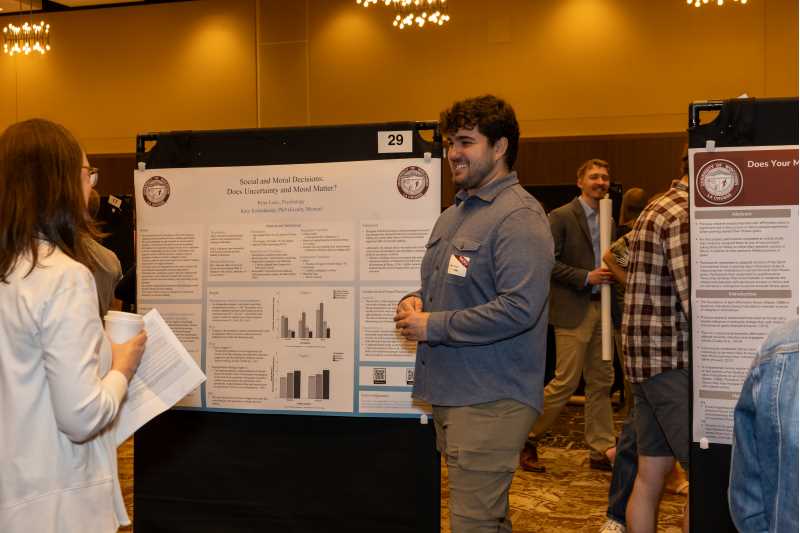
  • How to communicate the results of your work through poster and oral presentations and papers
  • How to work collaboratively with a faculty mentor and/or other student colleagues

You are also likely to increase your self-confidence in your ability to carry out a major project, and recognize whether or not post-graduate research (graduate school) is for you.

Will this help me beyond college?

No matter what you plan to do after you graduate, experiencing in-depth research scholarship will help you. The skills you learn will be applicable in a job environment or in graduate school. Both prospective employers and graduate schools recognize that students who have this kind of experience are better prepared than many of their peers. Many students give presentations at professional meetings and some co-author papers or produce other published or juried products that help build impressive resumes.

How do I get started?
You can get involved in research and creativity projects in several different ways. 

  • You may develop your own idea for a scholarly or creative project based on class activities such as reading, research for class assignments, or in-class discussions;  approach a faculty member you think would make a good advisor for that project.
  • A faculty member whose class you take may observe that you have the potential to work independently, and invite you to participate.
  • You may learn of projects from more senior classmates who are doing research, or from faculty presentations, and ask the collaborating professor if you may join the project.
  • Review the undergraduate grant guidelines and deadlines and start preparing your proposal.

What does undergraduate research/creativity involve?

No two projects are alike; however, some activities and/or attributes are common to most projects. You need to:

  • Be self-motivated and work on the project consistently
  • Meet deadlines
  • Communicate often with your faculty mentor and collaborators, if applicable, and be clear on your role in the project
  • Read the literature of the discipline related to your project
  • Think deeply and creatively about your project
  • Produce a presentation on the results of your project, typically a poster or an oral presentation, paper, a performance or a show, or some combination of these
  • Enjoy the project for the intellectual stimulation and sense of accomplishment you have
You need to budget sufficient time to work on the project, so you may plan to:
  • Seek grant funding in the form of a stipend so that you can cut back on hours worked at other jobs
  • Plan to work on the project over the summer months and/or during semester breaks when your schedule may be easier
What knowledge and skills do I need?
You do not necessarily have to be far along in your major to become involved. Some projects require a lot of content knowledge, but for others you can learn what you need to know during the research project. 
The most important attributes you need to be successful are:
  • Interest and intellectual engagement in the project
  • Open communication with your collaborator(s) and faculty mentor(s)
  • A work ethic that makes you a dependable contributor in the project
  • An ability to see the project to the end and produce a final product, be it a poster or oral presentation or an artistic performance

Can I get funding to do research?

Once you’ve found a topic and faculty mentor, you can apply for an undergraduate research grant in either fall or spring semester. Students compete by completing a short grant proposal. Projects within the US can be funded for up to $1,500 for single investigators or up to $1,650 for projects with more than one student. Projects involving international travel can be funded for up to $2,100.
 
How much time will it take?

Although it is difficult to predict how much time a given research project might require, during the academic year the average student engaged in research works between 5 to 10 hours a week. Some research projects may require weekend or summer work; many summer projects represent full-time commitments for several weeks.

How do students present their research findings?

  • UW-L's Annual Celebration of Undergraduate Research and Creativity, held each Spring
  • UW-System Symposium for Undergraduate Research, held each Spring at various UW-System campuses
  • National Conference for Undergraduate Research (NCUR), also held each Spring
  • UW System’s Posters in the Rotunda in Madison, typically held each spring
  • Annual regional and national meetings of student societies and disciplinary societies
How do students publish their research findings?
  • UW-L Journal of Undergraduate Research
  • Reinvention: A Journal of Undergraduate Research
  • Peer-reviewed discipline-specific journals (discuss these opportunities with your faculty mentor)