
Archaeology Terms
Bows - Cade's Replica Traditional Self-Bows
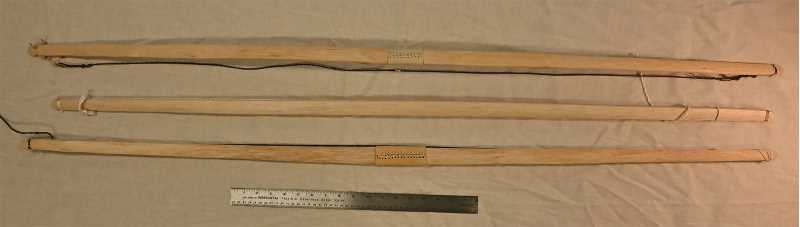 Three bows
Long-time MVAC friend Loren Cade has hunted and harvested deer previously using a traditional wood bow and arrows he made from local materials. In 2024 he was given a ca. 56-inch-long section from a 4 to 5 inch diameter hickory tree cut in ca. 1990, with the suggestion that he might want to make a traditional Native American style bow. Loren was happy to take on the task.
The most widespread bow style known in Native American societies of the postcontact historic era in the Upper Midwest are now referred to as self-bows. These are a one piece wood bow, typically made of hickory, and sometimes backed with animal sinew.
Loren split the well-aged hickory section into two halves and then split those halves into quarters. He then had four bow blanks, called staves. Carefully working down each stave in turn, he produced four bows 52 to 55 inches long. Shown here are three of them (Top).
When finished, bows number 5, 6, and 7 were found to have pull weights of 47, 50, and 39 pounds, respectively, when strung and drawn back 24 inches to fire an arrow of appropriate length (Bottom). The general recommendation for hunting deer is a pull weight of 40 to 50 pounds, so these were in the right range. The fourth bow shattered when drawn back to a firing position.
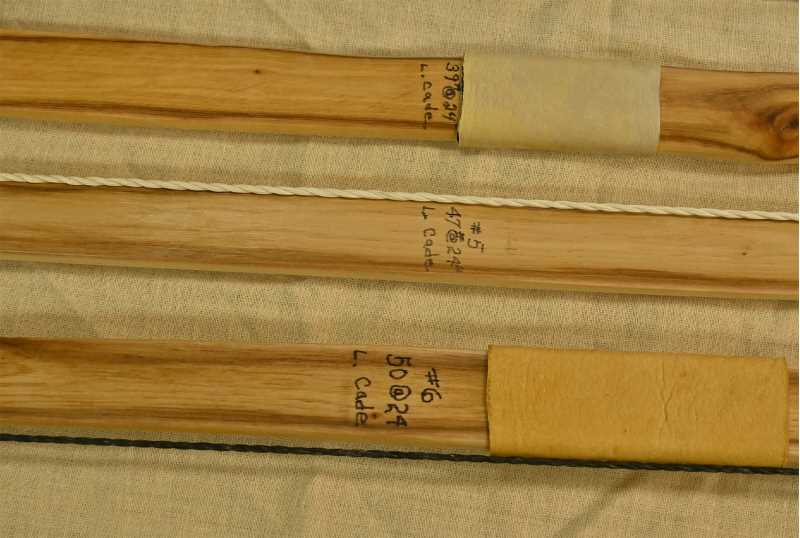 Close-up three bows
Loren has donated bow number 5 to the Vernon Co. Wisconsin Historical Society and bow number 6 to MVAC.
The earliest surviving Native American bow is the hickory "Sudbury Bow" (ca. A D 1660) attributed to Algonquian people in New England.
References:
See The Traditional Bowyer's Bible Vol 1-3.
1992 Vol. 1 Bois d' Arc Press,
1993 Vols. 2 and 1994 3, The Lyons Press, New York, New York.
(Entry by Dr. James Theler)

at the University of Wisconsin-La Crosse
Contact us
- 1725 State Street
La Crosse, Wisconsin 54601 USA - Call 608.785.8463
- Email us