
Artifacts
Mastodon – Boaz
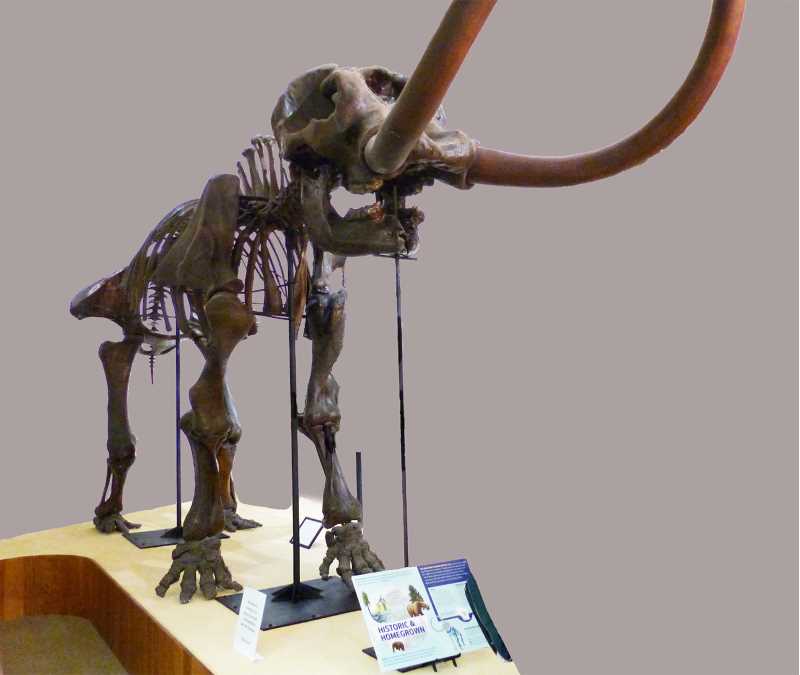 Boaz Mastodon
The most spectacular exhibit at the UW-Madison Geology Museum is the imposing 10-foot-high reconstructed skeleton of the Boaz Mastodon. Mastodons and mammoths, like their modern elephant relatives, were massive. They lived south of the glacial ice across much of North America until the end of the Ice Age (Pleistocene Era) about 11,000 to 12,000 years ago. It’s no surprise that the huge bones of such animals draw attention whenever they’re encountered. Wisconsin’s Driftless Area, which was not covered by glacial ice, has produced scattered bones of mammoths and mastodons, including some in La Crosse County (see links below).
Some boys found the Boaz Mastodon in 1897 after heavy rains uncovered the enormous bones on their farm, near the town of Boaz in Richland County, Wisconsin. The bones were recovered and taken to UW- Madison, where they and bones from other mastodons (especially those from nearby Anderson Mills) were used to create the composite mastodon that’s on display today. The Boaz bones have now been dated to about 12,000 years ago, and recent detective work has shed light on the display’s fascinating history: https://archive.jsonline.com/news/wisconsin/researcher-unravels-century--old-wooly-tale-to-find-truth-behind-legendary-massive-bones-b99502786z1-304635421.html.
The presence--and probable association--of a stone spearpoint with the Boaz bones suggests that human hunters might have played a role in the Boaz Mastodon’s demise (see Palmer and Stoltman reference below). The spearpoint is a Clovis type, with a flute on each side for hafting to an atlatl dart or spear shaft. It was made from a distinctive toolstone called Hixton silicified sandstone, found at quarries in Jackson County, Wisconsin. Clovis points have been associated with other mastodon “kill sites” and are thought to represent the earliest widespread presence of humans across the Americas, south of the melting glacial ice masses to the north. The brief, continent-wide appearance of Clovis points around the time when mastodons disappeared have led to suggestions that hunting, along with climate change, might have led to the extinction of these low-density mammals. In any case, the Boaz find and the spearpoint found nearby hold a special interest for paleontologists and archaeologists alike.
Palmer, Harris A and James B. Stoltman
1976 The Boaz Mastodon: A Possible Association of Man and Mastodon in Wisconsin.
Midcontinental Journal of Archaeology 1 (2):163-177. (https://www.jstor.org/stable/20707793 )
Mammoths and Mastodons – Video
Chipmunk Coulee – Mastodon Tooth
(Entry by Dr. James Theler)

at the University of Wisconsin-La Crosse
Contact us
- 1725 State Street
La Crosse, Wisconsin 54601 USA - Call 608.785.8463
- Email us