
Posted 3:13 p.m. Wednesday, Feb. 4, 2026
Advancing the College of Science & Health through emerging technologies
As technology evolves rapidly — particularly in areas such as artificial intelligence — the need for a workforce prepared to navigate innovation-driven spaces has never been greater. For universities, that urgency carries a clear responsibility: to ensure students graduate with the skills, adaptability and critical thinking needed not only for today’s world, but for the one still taking shape.
Across teaching, research and community engagement, the College of Science & Health (CSH) is rising to that challenge. From joining a national research partnership that expands access to high-powered computing to securing a National Science Foundation grant aimed at responding to emerging industry needs, the college is positioning itself at the forefront of technological change.
At the heart of that effort is a commitment to keeping curriculum relevant to the world students will enter after graduation, explains Whitney George, associate dean of the CSH.
“We want to make sure students are prepared for the world they’ll be living and working in,” says George. “What and how we teach will always be influenced by technological change.”
While the college's core values around education remain the same, George says they need to determine if delivery of the material is keeping pace with current educational trends.
“By keeping up with current trends in emerging technological advancements, we demonstrate to potential students we care about their future and will provide them the education they need for the world they will live in.”
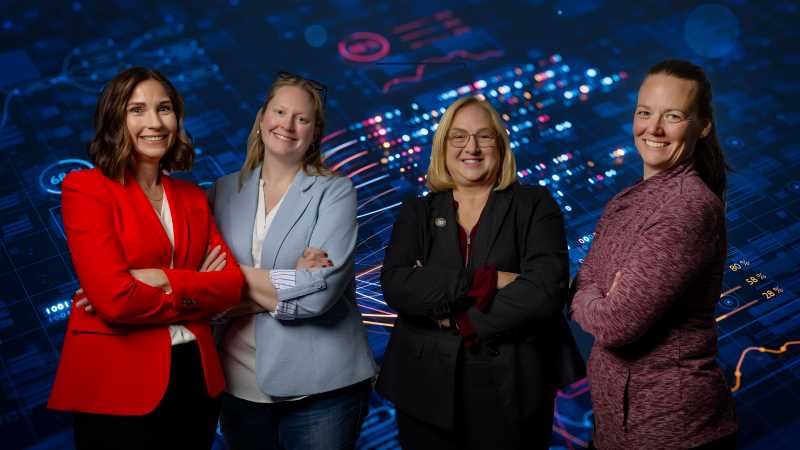
That growing focus on emerging technologies has also highlighted the need for clearer coordination and shared messaging across the college. In response, the CSH created a new AI faculty fellow position, with Megan Litster, UWL associate professor of health professions, recently appointed to the role.
Litster will collaborate with CSH departments, the Center for Advancing Teaching and Learning (CATL), and other campus partners to help faculty explore, understand and integrate AI into teaching and research. Her role is intentionally flexible and will continue to evolve as AI technologies change and as she learns more about faculty and student needs.
Litster emphasizes that her role is not to persuade faculty to adopt generative AI, but to support thoughtful engagement across a wide range of perspectives.

“I don’t think it is my role to convince anyone that they have to support AI and use generative AI without pause. I am here to be a cheerleader and a support system for all thoughts along the continuum of generative AI use,” she says.
She notes that ethical, educational and environmental concerns surrounding AI mean that hesitation and skepticism — from both faculty and students — deserve space in the conversation.
Regardless of where individuals fall on the AI spectrum, Litster sees a growing need for AI literacy across campus. She describes generative AI as one of the most significant challenges to teaching and research she has encountered, underscoring the need to help faculty and students understand both its strengths and its limitations.
While conversations about responsible use, transparency and the limitations of AI tools are already happening across campus, Litster hopes to sustain and deepen those conversations in a structured, meaningful way. Ultimately, her work will help make CSH faculty more aware of resources and highlight opportunities to engage with generative AI ethically and responsibly — especially for faculty who may not have the time to fully explore the rapidly evolving landscape on their own.
“The college doesn’t take the stance that AI is inherently good or bad — but we also don’t believe it’s just a passing fad,” George says. “We have to acknowledge that change is coming and be proactive rather than reactive.”
Building capacity for innovation through partnerships
A new federal grant is helping UW-La Crosse take that proactive approach by strengthening connections between the university and industry partners — and aligning student learning with rapidly evolving workforce needs.
A $400,000 National Science Foundation (NSF) Enabling Partnership to Increase Innovation Capacity (EPIIC) grant will allow UWL to better understand and respond to the needs of industry, nonprofit and civic partners, particularly in areas shaped by emerging technologies such as artificial intelligence.
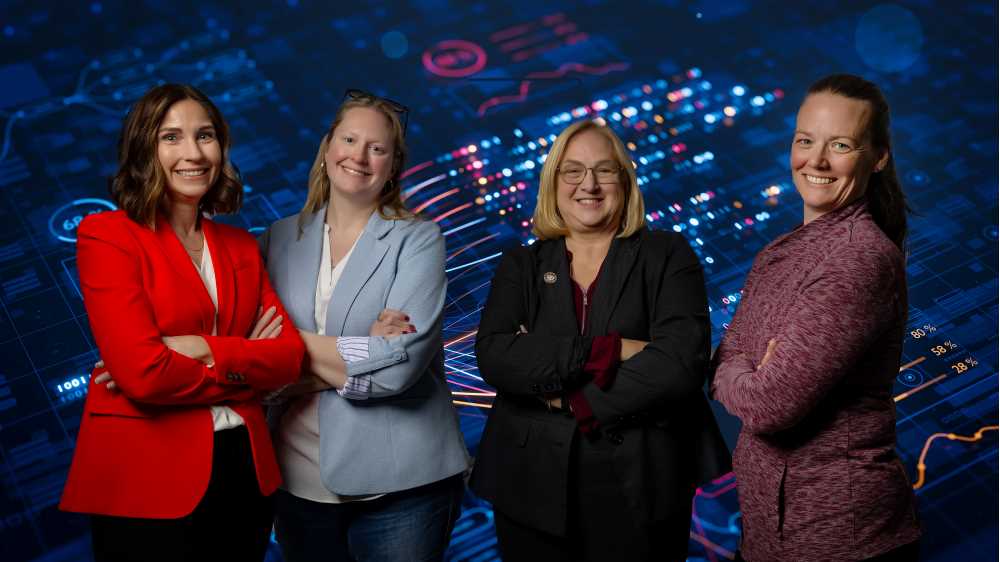
The three-year grant is led by three principal investigators: George; Marie Moeller, associate dean of the College of Arts, Social Sciences & Humanities; and Betsy Morgan, UWL provost.
“Innovation is always happening in industry,” says George. “But the university’s ability to keep pace — especially when it comes to expensive equipment or software — can be limited. Building strong partnerships is an innovative way to address workforce needs while providing real-world learning opportunities for our students.”
The grant will support several initiatives aimed at building sustainable, innovation-driven partnerships, including:
- Community engagement software to establish clear processes for initiating, tracking and maintaining collaborations with community and industry organizations — something employers increasingly request as AI and other technologies reshape workplace demands.
- Workshops and listening sessions with industry partners to gather ongoing feedback about how emerging technologies such as expectations around AI literacy and technical competencies are changing, helping ensure students across all majors are prepared to use new tools responsibly and effectively.
- Faculty fellowship support, providing three faculty fellows with dedicated time to grow and maintain partnerships with community organizations, connecting faculty expertise with emerging industry needs.
Together, these efforts advance UWL’s broader commitment to community engagement and innovation — both key priorities in the university’s 2025-30 strategic plan.
AI in the classroom
Emerging technologies are also reshaping how students learn — and how faculty teach.
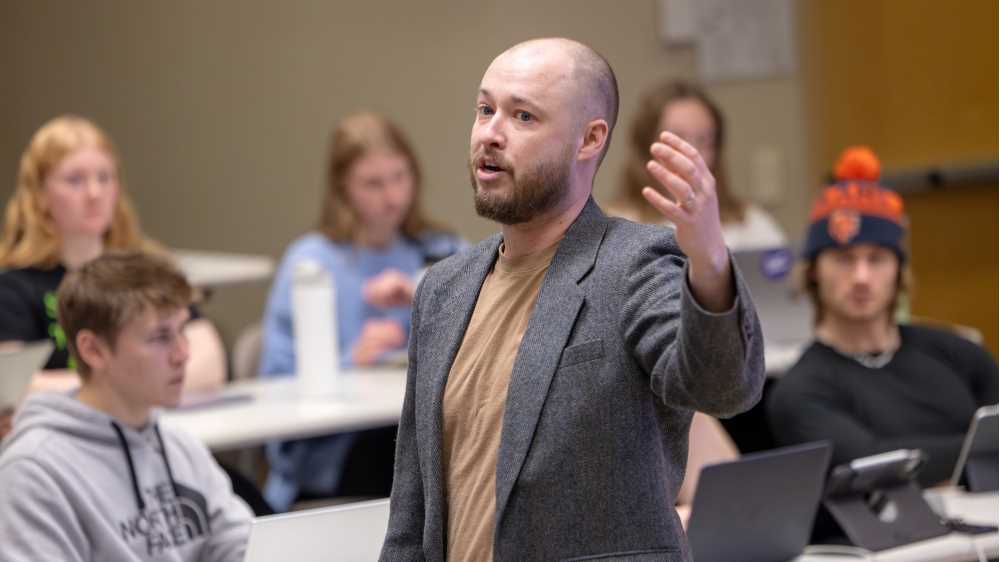
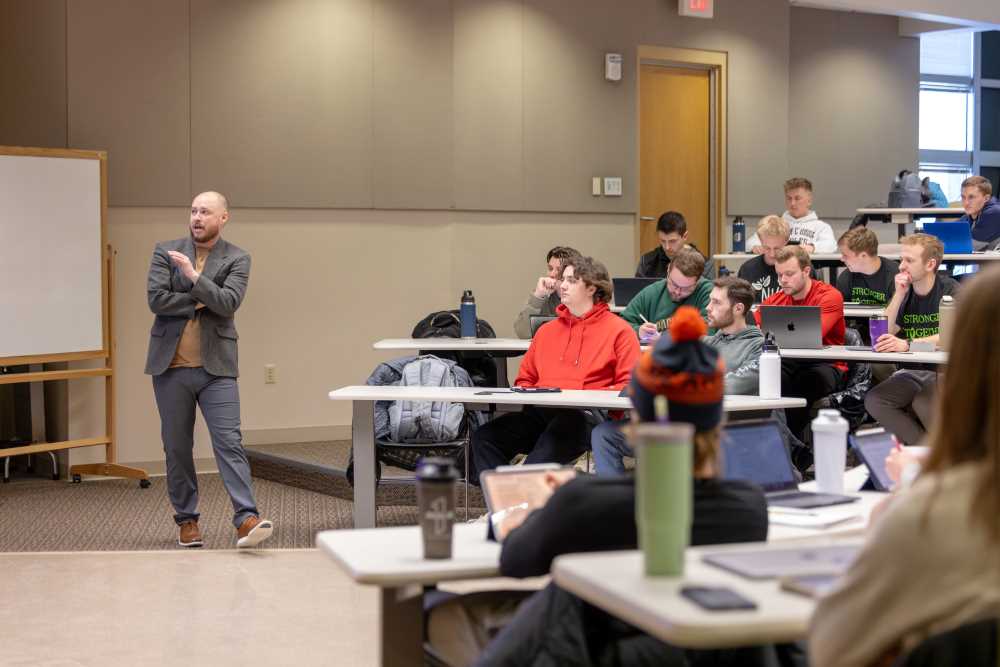
An example is a course focused on research methods and evidence-based practice for future physical therapists, where Assistant Professor Shane Murphy teaches students how to make clinical decisions using the best available scientific evidence.
The course exposes students to scientific literature and emphasizes the skills needed to be informed, critical consumers of research. With support from CATL and the Science of Learning Institute’s Enhancing Learning initiative, Murphy has developed a framework for integrating artificial intelligence into course activities. Through this approach, students learn how to use AI tools to search for evidence related to health topics such as specific treatments, communicate that evidence clearly to patients, and better understand the limitations of generative AI. Students experiment with multiple search engines and a variety of prompt structures to evaluate the quality and reliability of AI-generated responses.
“The aim is not to give up clinical decision-making,” says Murphy. “Rather, if we are sending our students out to be clinicians, we need to make sure they understand how artificial intelligence will change access to information and how future patients may come with preconceived notions about their prognosis.”
Powering research together

While AI is transforming classrooms, emerging technologies are also expanding the scale of scientific research — an effort UWL is actively contributing to. Since Nov. 14, UWL has been running computational experiments for researchers across the country, joining other institutions including Yale University, Massachusetts Institute of Technology and Carnegie Mellon University. This project supports work in fields ranging from astrophysics and biomedical engineering to marine sciences.
Fourteen department servers have already processed more than 966,000 computing jobs —work made possible through UWL’s participation in a national partnership that pools computing and storage resources for scientific research.
UWL recently joined the Open Science Grid (OSG) Consortium, a nationwide collaboration of universities and research institutions that share computing power to support high-throughput scientific computing. Founded at UW-Madison, OSG provides vetted researchers access to a massive, distributed computing infrastructure that allows them to run experiments at a scale far beyond what a single computer — or even a single campus — could support.
Adding more computers dramatically expands what researchers can do, explains Mike Petullo, assistant professor in UWL’s Computer Science & Computer Engineering Department. “A physicist studying black holes, for example, could program a simulation and run it on the thousands of computers that make up the cluster — such a simulation might take much, much longer to run on a single computer," he says.
UWL’s participation in OSG is possible largely because of strategic use of existing resources. Instead of sending older machines to auction, the department reconfigured them and added some open-source software so they could contribute to the national computing pool. Additionally, because computing demand from UWL students and faculty fluctuates throughout the day and year, the department is able to share spare capacity without impacting local needs.
“Our motivation is to maximize the value of the technology investments we’ve already made, while still preserving our ability to meet departmental computing needs,” Petullo says. Participation in OSG also helps position UWL for future growth. The department hopes to eventually pursue grant funding to expand scientific computing capacity beyond Computer Science & Computer Engineering — and demonstrating the ability to manage shared resources is a key step toward that goal.
Researchers across the country, including those at UWL, can apply for access to OSG resources. While users must be able to write and manage their own software experiments, the system provides access to computing power that would otherwise be difficult to obtain. Because UWL contributes to the pool, researchers submitting jobs may even find their experiments running on UWL servers.
Beyond its involvement with OSG, the Computer Science & Computer Engineering Department maintains a wide range of computing systems and services that support teaching, learning and research. These resources exceed what is typically available at institutions of similar size, helping position UWL at the forefront of emerging technologies.