

Posted 10 a.m. Wednesday, July 8, 2026
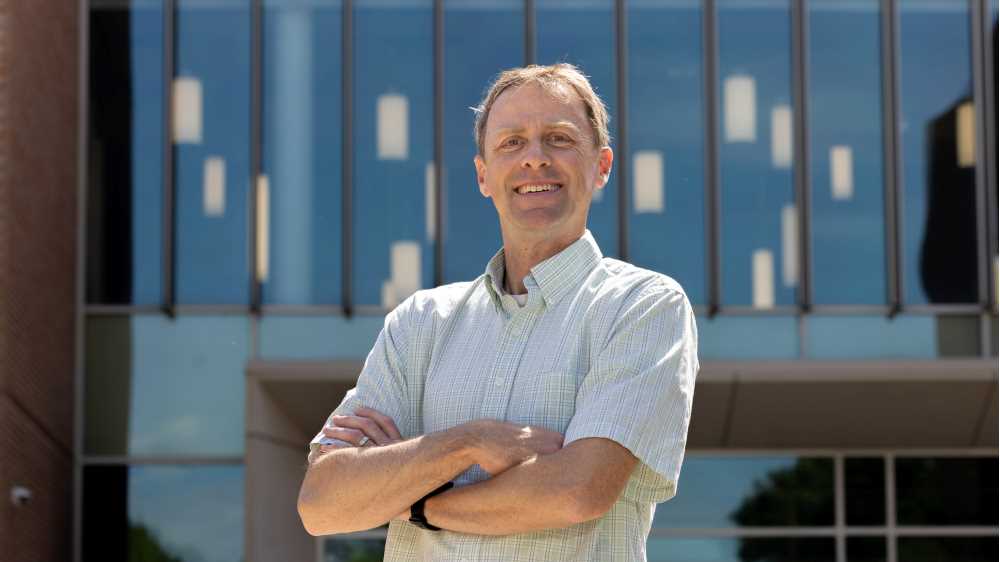
John May receives Eagle Research & Creativity Mentoring Excellence Award
Now in its second year, the Eagle Research & Creativity Mentoring Excellence Award recognizes UWL instructors who go above and beyond in their support of students pursuing research and creative projects.
Undergraduate and graduate students nominate faculty/IAS research mentors with whom they have had a particularly positive experience associated with:
- Providing significant support to student learning inside or outside the classroom
- Expanding student understanding of scholarly/creative ideas
- Helping students accomplish research/creative goals
- Providing learning opportunities students would not otherwise be able to access
- Helping students understand new ways of approaching scholarly/creative questions
- Providing students with leadership opportunities
- Helping students build confidence in their scholarly/creative area
- Opening new opportunities for students academically/professionally.
Students receive a form to nominate instructors in the spring. The Undergraduate Research & Creativity Committee makes recommendations to the Provost’s Office, which reviews the nominations and selects the winner.
This year’s recipient is John May, professor of chemistry and biochemistry.
John May, Chemistry & Biochemistry
Started at UWL: 2015
Courses: General Chemistry I (CHM 103), Biochemistry I: Macromolecules (CHM 417), Advanced Biochemistry Lab (CHM 419), and Biochemistry of Antimicrobials (CHM 445)
Background: Before coming to UWL, I was a postdoctoral fellow in microbial pathogenesis at Yale School of Medicine. Prior to that, I was a doctoral student in biochemistry at UW-Madison.
Research mentorship responsibilities: My overall mentorship goals are to train students in scientific thinking and to provide experiences that will serve them throughout their careers. Since starting at UWL, I have mentored 30 undergraduate students, and most carry out research for multiple semesters and/or summers in the lab. Each student works on their own project that is part of a larger project in my research lab. I mentor students in all parts of laboratory research, including planning and carrying out experiments with their own hands, applying for grants, and presenting results at local, regional and national meetings.
Favorite part of mentoring students in research: My favorite part of mentoring is helping students grow in confidence and independence as researchers. The most rewarding moments are when students contribute their own ideas to any aspect of the research process, from improving protocols and proposing new lines of experiments to enthusiastically communicating results. The sense of ownership they develop through undergraduate research will carry forward into whatever career path they pursue.