Accessibility menu

Skip to main content Skip to footer
Return to calendar

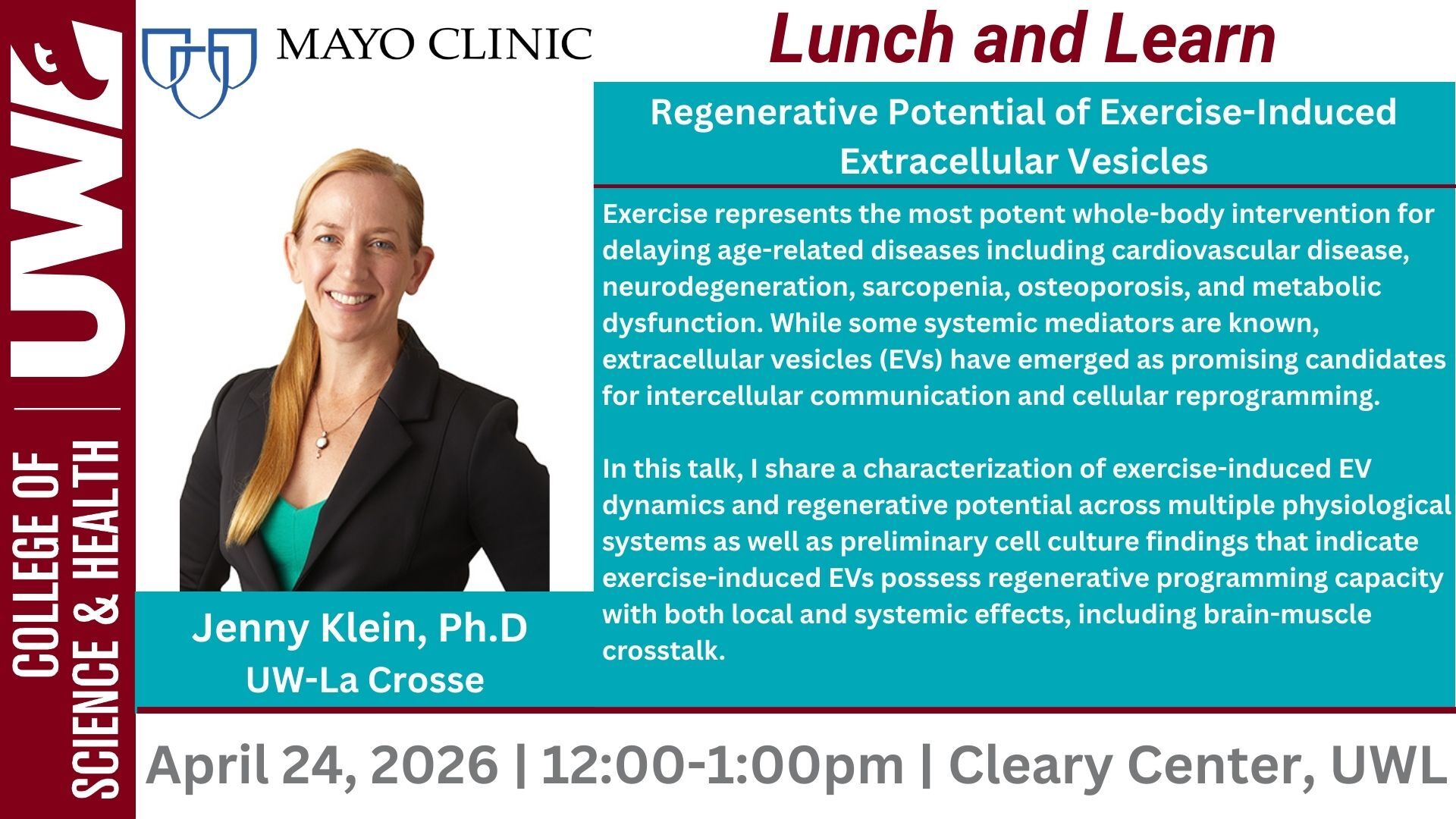
UWL & Mayo Lunch and Learn

Regenerative Potential of Exercise-Induced Extracellular Vesicles

Please join us in welcoming Dr. Jennifer Klein who will be our next UWL & Mayo Lunch and Learn speaker.

Background:

Exercise represents the most potent whole-body intervention for delaying age-related diseases including cardiovascular disease, neurodegeneration, sarcopenia, osteoporosis, and metabolic dysfunction. While some systemic mediators are known, extracellular vesicles (EVs)—membrane-bound nanoparticles released into circulation following exercise—have emerged as promising candidates for intercellular communication and cellular reprogramming. These vesicles carry informationally complex molecular cargo including microRNAs, proteins, and lipids with potential to mediate exercise's pleiotropic benefits.

Preliminary Findings:

Our group has characterized exercise-induced EV dynamics and regenerative potential across multiple physiological systems. In college-age male athletes, we observed 40% increases in circulating EV concentrations immediately post-exercise, with magnitude correlating to resistance training intensity. Functional studies reveal that exercise EVs promote dose-dependent neurite outgrowth in SH-5YSY neuroblasts during neurogenesis, suggesting potential roles in neuroplasticity enhancement. Microglial cultures exposed to exercise EVs from young and old male participants undergoing moderate-intensity resistance exercise demonstrate shifts toward immune-regulatory phenotypes. MicroRNA sequencing of these EVs identified differentially regulated miRNAs implicated in neurogenesis, amyloid-beta metabolism, microglial activation, dendritic spine remodeling, and synaptic plasticity.

In muscle regeneration models using C2C12 progenitor cells, we observed temporal specificity in EV function: EVs collected immediately post-exercise preferentially drive muscle stem cell proliferation, while EVs collected 24 hours post-exercise promote differentiation and myotube hypertrophy. This temporal programming suggests EVs orchestrate sequential phases of muscle repair and regeneration with remarkable precision.

Significance:

These preliminary cell culture findings indicate exercise-induced EVs possess regenerative programming capacity with both local and systemic effects, including brain-muscle crosstalk. The temporal dynamics, dose-dependent responses, and tissue-specific effects we observe raise critical mechanistic questions regarding EV biogenesis, cellular targeting, and functional specificity. Understanding these mechanisms could inform therapeutic strategies for age-related disease. This work establishes foundational observations that warrant deeper investigation through collaborative efforts and represents fertile ground for grant proposals exploring exercise mimetics, EV-based therapeutics, and precision medicine approaches to healthy aging.

When

  • Noon to 1 p.m. Friday, April 24

Where

Allen Conference Room, 125 Cleary Alumni & Friends Center

UWL campus map for building location and nearby parking lots.

University of Wisconsin - La Crosse Cleary Alumni & Friends Center

If you go

  • Free, no registration needed

Contact

For questions about this event or to request disability accommodations , contact Whitney George at 608.785.5107 or wgeorge@uwlax.edu.

Parking

Payment may be required. No permit?
Use Passport Parking.

Additional parking info
Website for Parking | Email for Parking | Call for Parking

Loading...