

Posted 3:50 p.m. Friday, Feb. 27, 2026
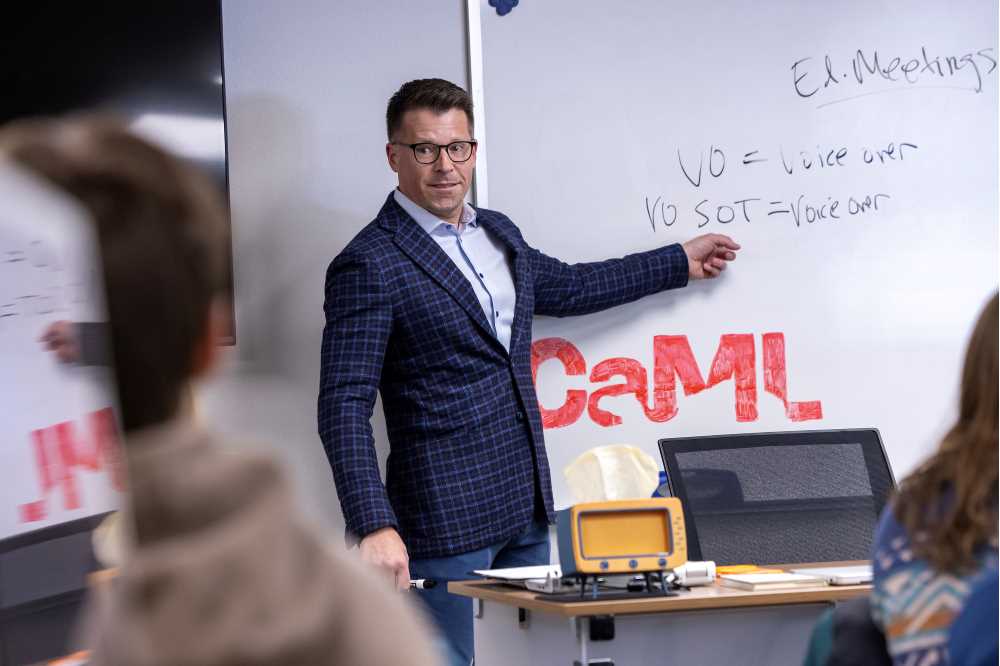
Chicago anchor and UWL alumnus discusses change, resilience in media today during class visit
Alumnus Sean Lewis, a nearly two-decade veteran anchor at WGN-TV Channel 9 in Chicago, has simple advice for students hoping to break into broadcast journalism:
“Remember your credibility is everything. First, be right on the facts. Next, be first —with the right facts,” he says.
On Thursday, Feb. 26, Lewis, who started his career in TV journalism at UWL, returned to campus for the first time since 1997 to speak with students in CST 371: Media Industries and Audiences in the Communication & Media Lab. His visit offered a real-time case study aligned with the course’s focus on how media industries operate — from ownership and branding to labor, regulation and audience targeting.
“Through Sean’s perspective, students could connect abstract industry concepts to lived professional realities, especially because of his work in a top-three market,” says Taylor Cole Miller, assistant professor of media studies, who teaches the course.
Lewis’ visit came at a pivotal moment for the industry. Newsroom layoffs and corporate restructuring — including recent cuts at WGN-TV’s parent company, Nexstar Media Group — highlight the volatility facing today’s journalists.
“Local broadcasting is a powerful example of how media industries operate at the intersection of community service, commercial pressure and corporate ownership,” Miller says. “We are at a moment of significant transformation in television news, with consolidation, layoffs and evolving digital demands. I thought it was important for students to hear from someone actively navigating those challenges.”
Industry volatility and labor precarity are frequent topics in Miller’s classroom. Students examine consolidation, technological shifts and audience fragmentation, while also building skills that transcend any single platform.
“One thing I try to do is train students for media careers more generally,” Miller says. “In 2026 with technology moving as quickly as it is, the specific programs and even the media landscape more broadly will likely change between their last day of class and their first day on the job.”
Adaptability, he adds, is essential.
Although UWL does not currently have a journalism program, Miller frequently partners with local TV stations (WKBT, WEAU, and WLAX) to provide students with applied skills in broadcast training with content that frequently airs on TV. “Students need strong reporting and storytelling skills, but they also need digital fluency, audience awareness and the ability to work across platforms,” Miller says. “An understanding of industry, branding and audience will help them enter the field. But equally important are ethical judgment, critical thinking and resilience. Journalism today requires professionals who can maintain trust while navigating rapid structural change.”
Lewis gave students an inside look at that reality. He walked them through his recent coverage of a fatal bank robbery in Chicago, outlining the process from editorial meetings to coordinating with the FBI.
“It’s one thing for students to read about FCC station ownership caps, advertising pressures or labor precarity,” Miller says. “It’s another to hear from a professional a step-by-step breakdown of how a newsroom works and how journalists apply their training and ethics to serve the public.”
Miller regularly brings industry professionals from across media fields into his classes. Later this semester, students will hear from a Standards & Practices professional whose experience spans network entertainment and children’s programming.
Lewis received his initial broadcast training in the university’s former student-run TV studio. Working alongside classmates to produce a newscast under the mentorship of Pat Turner, faculty emerita of communication studies, he learned the rhythms of daily news production.
“It was great experience for what I do now every day,” Lewis says.
While classes were important, one of his most meaningful experiences was serving as a resident assistant in Coate Hall, he says.
“It was a great group of people, and I learned so much about leadership and how to work with a diverse group of people.” he says.