

Posted 10:03 a.m. Thursday, Oct. 22, 2026
Fulbright research explores one of India's iconic stolen artifacts
Museums around the world are quietly rewriting history, returning priceless cultural treasures taken during colonial rule or stolen through the illegal antiquities trade. Recent stories have reported the return of the Benin Bronzes to Nigeria and hundreds of looted antiquities from the United States to Italy.
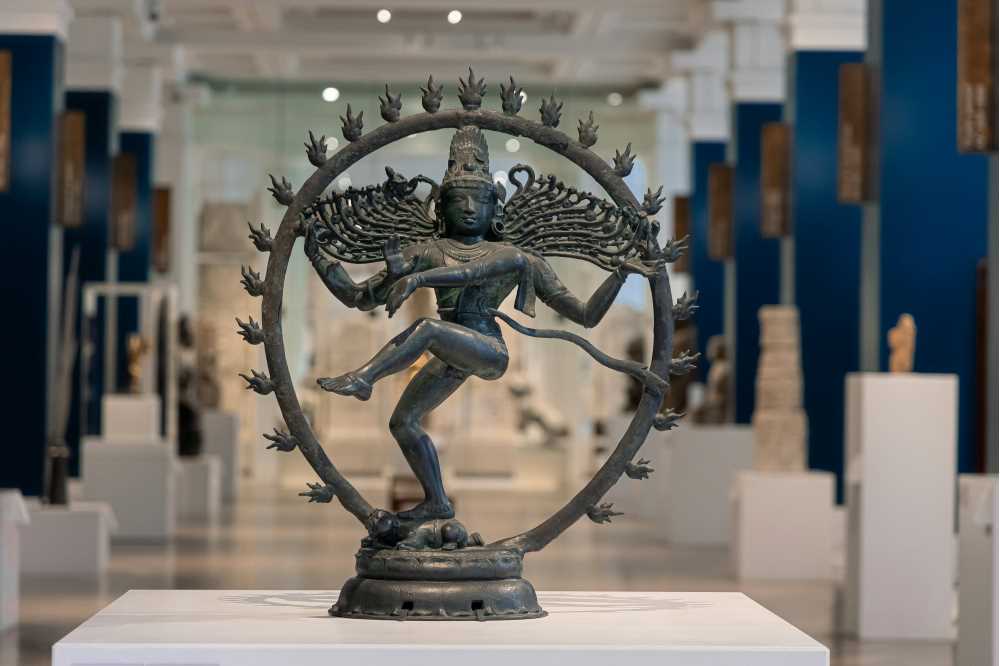
For UW-La Crosse History Professor Gita Pai, those high-profile restitutions are more than international news. They are central to her latest research. During the 2026-27 academic year, Pai is examining one of India's most celebrated cultural icons: Shiva as Nataraja, the Lord of Dance, whose stolen bronze sculptures have become symbols of the global movement to return cultural heritage.
One case, in particular, drew her in. In 2014, Australia's prime minister returned an 11th-century bronze Nataraja sculpture to India after it had been stolen from a village temple in Tamil Nadu and smuggled overseas before eventually ending up in an Australian museum.
Her research explores how Nataraja became one of the defining images of Indian art and identity — and why sculptures depicting the Hindu deity have become some of the world's most sought-after stolen artifacts. Through her Fulbright-Nehru Academic and Professional Excellence Fellowship, Pai aims to understand why this particular sculpture was stolen in 2014, how it traveled across international borders, and why its return became the subject of diplomacy between world leaders.
Pai's work traces the sculpture's journey from its origins in medieval South India to its role today in debates over cultural heritage, museum ethics and the international antiquities trade.
Her research combines archival work, ethnographic fieldwork and interviews with villagers, priests, dancers, police officers, activists and museum professionals. The project will culminate in a forthcoming book, “In Pursuit of Dancing Śiva: The History of India's Iconic Cultural Treasure,” which examines how cultural and religious objects become global cultural symbols — and how their meanings change as they move across borders.
"My project addresses a highly relevant and pressing issue," Pai says. "It appeals not only to scholars and the general public interested in history, religious studies, art history, literature and museum studies, but also to museum professionals, policymakers and anyone interested in cultural heritage and ethics. The case studies of stolen Nataraja statues add compelling narratives to these broader conversations."
Her research has taken her throughout the Tamil region of southern India, where she has observed the Thiruvadirai festival dedicated to Nataraja at important Saiva temples while conducting interviews and archival research across multiple countries. Previous support from the American Institute of Indian Studies, a UWL Faculty Research Grant, a UWL International Scholarship Grant, the College of Arts, Social Sciences, & Humanities (CASSH) Small Grant, a Princeton University Library Research Grant, and an earlier Fulbright-Nehru Academic and Professional Excellence Fellowship made much of that work possible.
During her Fulbright fellowship, Pai will complete the final two chapters of her book. They examine Shiva Nataraja's role in early devotional worship in South India and include translations of medieval philosophical texts and temple inscriptions written in Tamil, one of the world's oldest continuously spoken languages.
For Pai, the project is also personal. Growing up in Texas, she heard stories from her mother about her maternal grandfather in India, who spent his free time carving Hindu deities from coconut wood and sculpting clay busts of South Asian historical figures. Although Pai never met him — he died when she was 3 years old — she believes his artistic passion helped shape her own academic path.
"I think that my grandfather inadvertently inspired me to study South Asian religions and history in general, and I carry on his legacy through creations of my own, such as the articles and books I write about India," she says.
After her family later moved to California, her immigrant parents sought opportunities to connect their children with South Indian culture. They regularly attended Tamil-language film screenings at UC Berkeley, where Pai became fascinated by the region's landscapes, language and traditions.
That fascination eventually became her life's work.
As a graduate student at UC Berkeley, she studied Tamil with the same professors who hosted those screenings while exploring the region's literary, religious and political history through coursework, research and travel.
Although her parents were born elsewhere in India, Pai emphasizes that Tamil Nadu was not part of her family's heritage.
"India's vast regional diversity means that geography, language and culture differ greatly, shaped by distinct food, dress, festivals and histories," she says. "Consequently, I have had to deeply immerse myself in Tamil culture and history in order to understand and write about it effectively."
Receiving another Fulbright to India carries special significance for Pai. The Fulbright-Nehru fellowship honors both U.S. Senator J. William Fulbright, who established the international exchange program, and Jawaharlal Nehru, India's first prime minister.
"It reflects not only the bilateral, cooperative nature of the fellowship — jointly funded by both governments — but also embodies both parts of my identity: a U.S.-born citizen with deep ancestral roots in India," she says.
