Posted 12:38 p.m. Monday, June 29, 2026
Finding the Connection
When most people think of the word “literacy,” their minds jump to language, reading, and writing, but when I think of this word, I think of the pool and a springboard beneath my feet. Sports, specifically diving, all have forms of literacy that need to be understood before immersing yourself in them. In diving, there is more than just speaking this literacy; there is the bouncing, timing, and patience with the board. There are different categories in diving, such as inwards and reverse, as well as different dive positions, including tuck, pike, and straight. But, when it comes down to it, diving is just like my relationship with writing. Two things, completely different motives and connections, are related more than I would have thought.
Diving has only been a part of my life for the past four years. But from it, I have learned more than I could in any classroom. First learning to dive might be one of the hardest moments that will stick with me forever. In diving, we use numbers to talk about the dives we do. There are specific requirements for the names of dives: “all dives are identified by three or four digits and one letter. Twisting dives utilize four numerical digits, while all other dives use three. The letter indicates body position: A = straight, B = pike, C = tuck, D = free” (USA Diving, 2026). So, when my coach, Caitlin, said, “Emma, do a 103B,” I sat there confused and worried I would do something wrong. Coming into practice where everyone knew how to communicate in these weird numbers and diver lingo made me feel out of place, even had me second-guessing myself and whether I really belonged. The more I practiced and pushed myself to understand, the more at ease and comfortable I felt. The numbers and letters that are used in diving have become my second language. Knowing the system of communication has helped me to form connections with my teammates, coaches, and other divers I meet. It gives me a sense of belonging to the sport and, more importantly, my team, a feeling shared by many of my teammates. Natalie Peterson, a current sophomore on the University of Wisconsin La Crosse Diving team, emphasizes that, “being able to speak and communicate with each other in diving terms allows us to be clear and concise when at practice or meets. It is a unique experience to have a language that most people do not understand. It is a little confusing at first to learn, but the more you use the terms, the more they become second nature” (Peterson, 2026). Like this, learning the language of writing has helped me to find that special connection in the classroom, not only with my ideas but with others as well. Our developed shared literacy, such as peer reviews and drafting, has helped me to feel a sense of belonging amongst my peers. Having this acceptance in the classroom has helped me to be more present when I am writing. It has also helped me to see myself not only as a student, but as a writer.
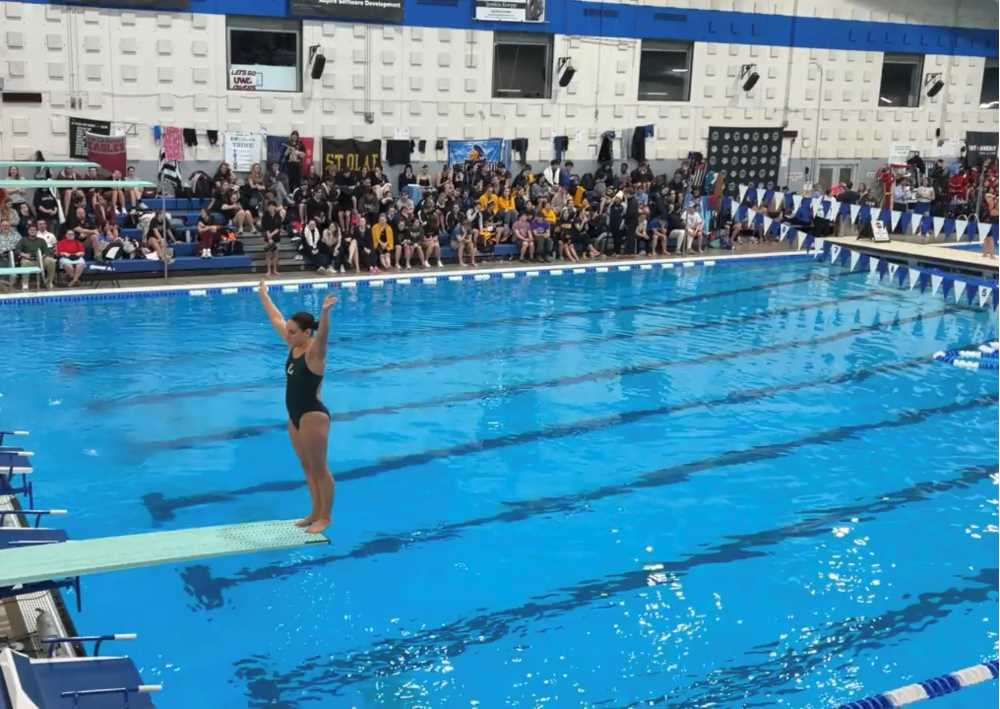
While the connections I have made with my team have helped me to improve, diving is still a mentally challenging sport. It requires focus, confidence, and mental toughness. Learning a new dive for the first time brings up almost every emotion possible. It is mentally challenging to push yourself to do something you fear. But in this sport, you have to trust your coaches, your training, and yourself to perform your best. As I stand on the rigid springboard, looking down towards the water, the smell of chlorine brings me to a comforting state. I tell myself to trust my body and that I know what to do, all while my teammates are cheering me on and helping me relax before I go. As I am walking down the board, many emotions rush through my head. “What if I bail out and hit the water?” “What if I hit the board?” Or “What if everything works out how it should?”
But, if there is one thing I have learned from trying new dives, it is that you will never know the outcome if you do not try at least once. Each time I execute a new dive, I realize I have prepared for this moment. I have worked hard to get here and worked even harder to continue moving forward, and this is the same for writing. Writing the first draft of a paper or essay is always nerve-racking. I never know where to start or where the piece will go. But I have to slow down and tell myself that everything I have done leading up to this point has prepared me to produce a strong piece of writing.
Along with the mental toughness required in diving, resilience is also needed. Doing my inward 404c for the first time after being injured gave me so much anxiety. I was worried about all the “what if’s” that could potentially happen. I set up on the board and told myself everything would be okay. I threw the dive and hit the water flat. Tears filled my eyes, and I felt so defeated. It was hard to decide what was worse, the pain after smacking, or the anger I had with myself. Before my injury, I could do this dive well, but afterwards, my head was filled with worries. I brushed myself off, looked at the bruises I got from the water, and told myself, “You have to do it again”. So, after talking with my coach and listening to his corrections, I got back up on the board to give it another shot. This time, I focused on the good things that could happen instead of the bad. I knew I had to change my mind set about how I approached this dive. Changing my mindset in diving often helps me be more successful, whether it is in practice or at meets. I could think of the dive as an obstacle that is stopping me from performing my best. Or I could think about it as a lesson for me to trust myself and believe that I can do it. Being able to shift my mindset from bad to good has helped me to grow as a person and overcome some of the challenges this sport has brought to me. Having a growth mindset is a strong feature to have because it can be applied to all aspects of life. When it comes to writing, it is often hard to have that growth mindset present. After writing many drafts, receiving multiple rounds of feedback, and often having to rewrite parts of the paper, it feels discouraging to start all over. I could think of it as another item to add to my to-do list, or as an opportunity to work toward perfection in writing and become an overall better writer. Not only does having a growth mindset help us shift how we interpret challenges, but it also helps us see every moment as a stepping stone toward getting further in life. Applying this to diving, I practice multiple times every day. The practices are a mix of lifting, pool practices, and dry land practices. I practice my dives over and over again, trying to perfect them. I continue to practice them to become comfortable with them and eventually do them without any negative thoughts. More importantly, I practice my dives so I can go out and perform them to the best of my ability. I train up for the bigger moments in my sports, the competitions. Similarly, this also applies to writing. I write out my ideas, brainstorm how to create a piece, and finally draft it. I draft multiple pieces and receive feedback. The editing and rewriting helps me to produce my best work; it prepares me for the bigger moment, the deadline. Finally, I have my polished, perfected draft to submit.
Every great diver once stood at the end of the diving board, staring at the water, toes curled, trying to figure out what to do next. Once they take that first dive into the water, the fears and worries tend to disappear. The same idea applies to writing. Every good writer has sat staring at a blank page with ideas in their head, not knowing how to make them a reality. But once you take that first “dive” into writing, the sentences start flowing. So, although I may have thought diving and writing would never have related, they do to me. The lessons I learned in my sport helped me to apply them to real life. It has helped me become a better, well-rounded person, and most importantly, it has helped me to see that I do have a love for both writing and diving.