

Posted 10:48 a.m. Thursday, April 9, 2026
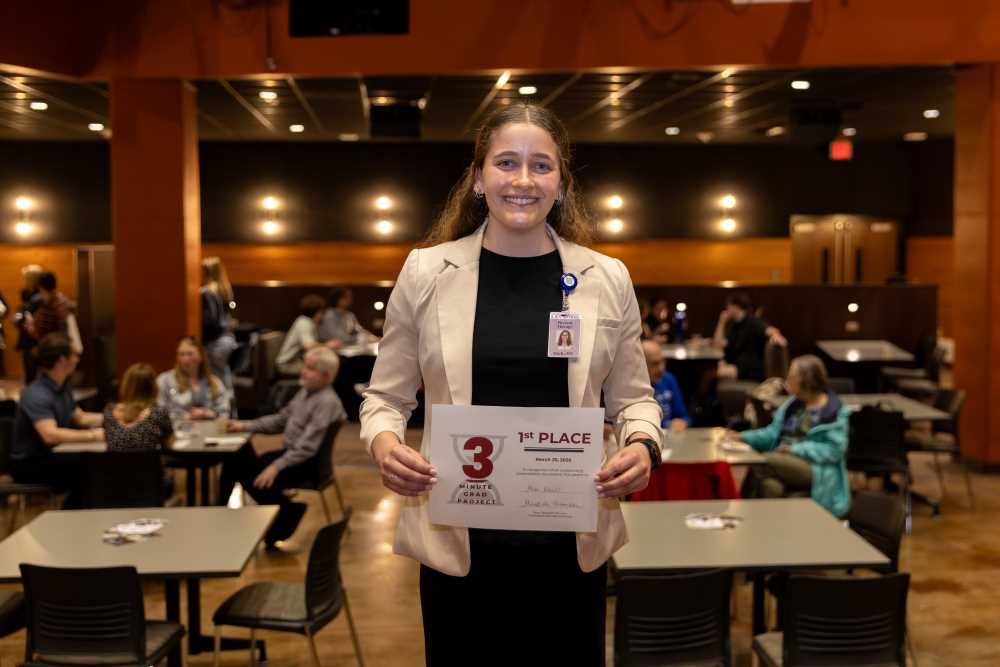
Mia Khalil earns top honors with 3 Minute Grad Project on wrestler safety
“In 1997, over the course of just 32 days, three young men lost their lives as they were trying to cut weight for wrestling competition. One of those men competed right here at UWL.”
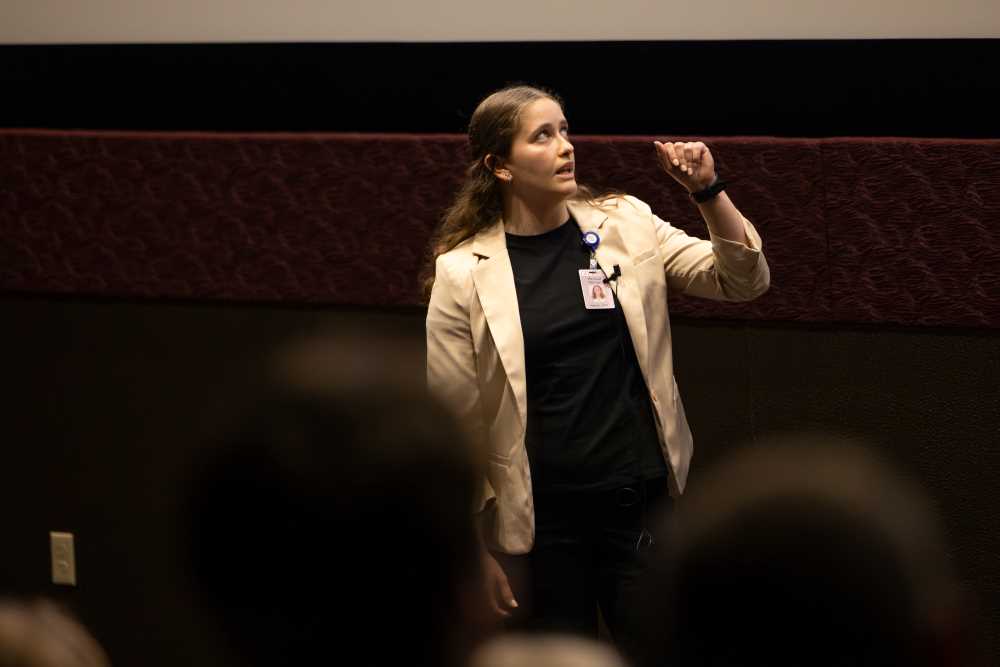
Those words caught the attention of judges and audience members at UW-La Crosse Graduate & Extended Learning’s 3 Minute Grad Project Competition, as Mia Khalil showed that impactful research doesn’t need much time to make a lasting impression.
The UWL physical therapy graduate student earned first place and the People’s Choice Award for her presentation, “How Skinfold Measurements Can Change Wrestler Fueling Plans,” and received two scholarships in the process.
Her research, conducted with faculty mentor Ward Dobbs, focuses on how different skinfold measurement methods, used to estimate body fat, can influence wrestler safety and performance.
“The research question was to investigate the differences between the three-site and seven-site skinfold methods and their estimations of body fat percentage,” Khalil, '24, explains.
The skinfold method is performed by pinching the athlete’s skin with a handheld tool, which records the thickness in millimeters. Higher readings indicate greater body fat. The three-site test takes measurements from the lower abdomen, shoulder blade and triceps, while the seven-site test adds the upper chest, bicep, hip and mid-thigh.
What Khalil found was significant.
“The three-site method yielded results that were approximately four percent higher than the seven-site method,” she says. “That gives wrestlers a greater range of weight they could lose before they hit their minimum wrestling weight.”
Those calculations matter under National Collegiate Athletic Association (NCAA) guidelines, which require athletes to remain above 5% body fat, a rule implemented after the deaths Khalil referenced in her presentation. Even small differences in measurement can significantly affect how much weight an athlete is allowed to lose safely. As of today, NCAA uses the three-site method.
While she notes the current system has improved safety, Khalil also sees room for progress.
“The three-site method has been effective in preventing those adverse effects,” she says. “But there could potentially be a better method using the seven-site.”
Khalil began the project in summer 2025, working directly with UWL wrestlers throughout the season.
“It’s been mutually beneficial,” Khalil says. “We get experience, and the wrestling team gets free data to help guide their training.”
Translating months of research into a three-minute presentation came with its own challenges.
“Explaining body fat, minimum wrestling weight and weight classes for a general audience with limited time was difficult,” she says. With guidance from Dobbs and feedback from peers and family, she refined both her message and visuals. “I wrote a script and practiced it over and over to make sure everything fit and made sense.”
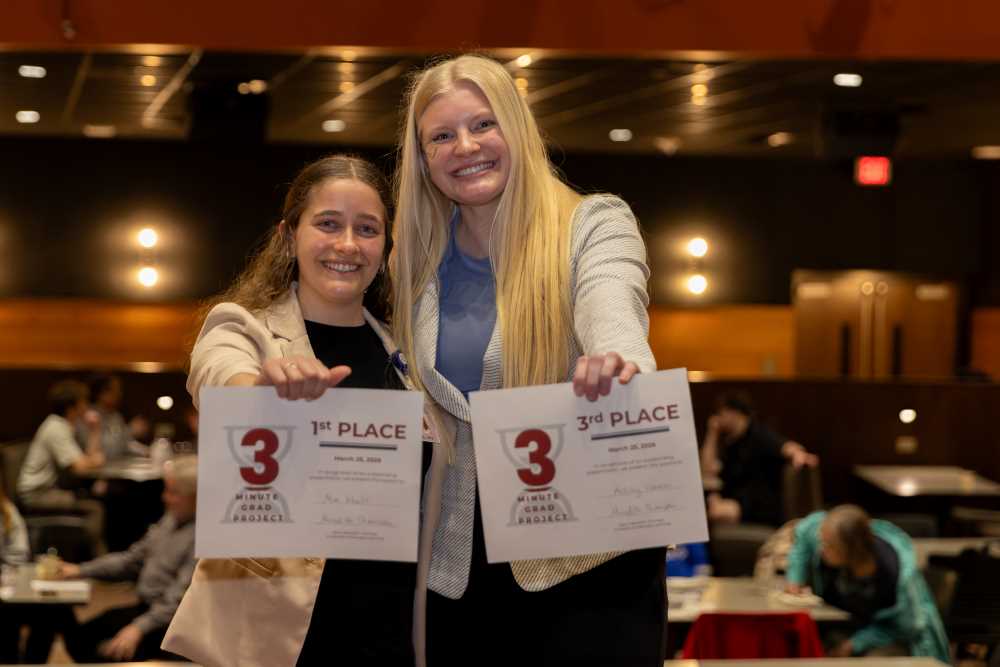
Despite her intense preparation, Khalil said winning was not her main focus.
“As long as I tried my best and informed people about my research, that was enough," Khalil says. “First place was the cherry on top.”
Her delivery resonated beyond the judges. After presenting, several audience members approached her to share their personal connections with the topic.
“I didn’t expect that,” she says. “It was really cool to hear from people who had related experiences to what I was talking about.”
Khalil believes her confidence and passion played a major role in earning both awards.
“Be confident,” she says. “If the audience can tell you care about what you’re talking about, that goes a long way.”
Khalil will present her research at the American College of Sports Medicine Conference this May before continuing her clinical training across the country.
Having completed her undergraduate degree in exercise and sport science at UWL, Khalil says staying in La Crosse for graduate school was a natural next step that has helped her grow as a researcher and emerging professional.
“The program here is fantastic,” Khalil says. “I feel really lucky to continue my journey at UWL and can’t say enough good things about it.”