Posted 11:20 a.m. Thursday, April 9, 2026
Internationally recognized sculptor connects with students while creating sustainable work on campus
Danny Ness, an art education major and dedicated sculptor, rarely sketches before starting a piece. He doesn’t need to — he can see the finished work in his mind.
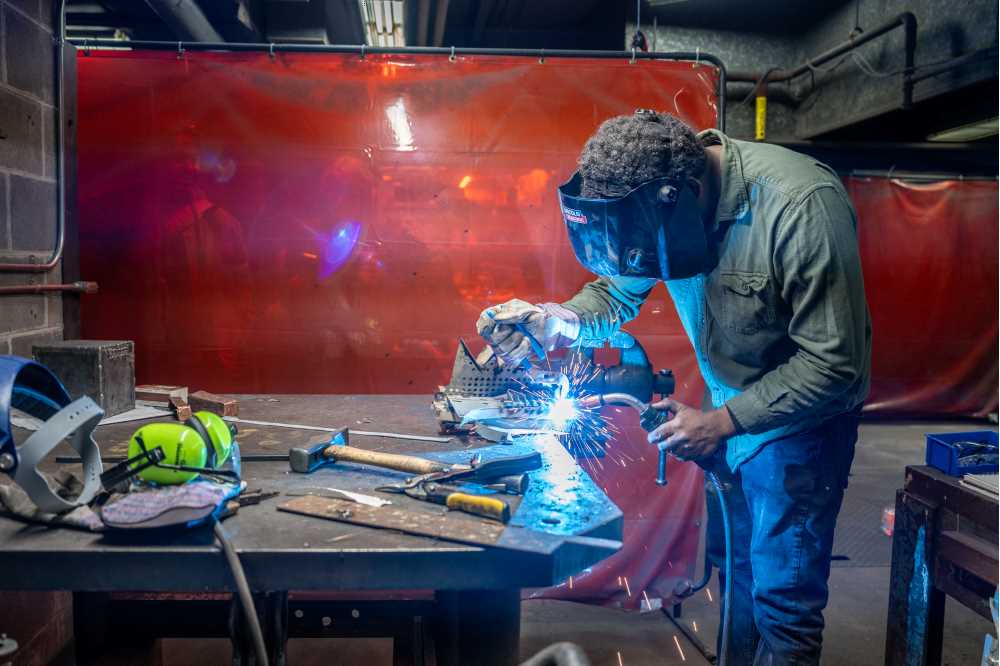
But that began to change after he watched Wilay Méndez Páez, an internationally-recognized sculptor, at work. During a campus workshop, Méndez Páez kept a sketchbook open beside him, a loose outline guiding the sculpture as it took shape.
For Ness, the moment was eye-opening.
“As an artist, I was blown away by how quickly he was able to fabricate such a beautiful sculpture — working with metal is typically a very time-consuming process,” says Ness.
After the workshop, Ness spoke with Méndez Páez, who encouraged him to incorporate more drawing into his process. Sketching, he explained, helps him develop his flow and energy that goes into the sculpture — allowing him to work more decisively and efficiently when shaping the final piece.
Méndez Páez brought a week of ideas and creative energy to UW-La Crosse this spring through a public talk, hands-on workshop, and pop-up exhibition. Wilay, who is also a poet, visited two sections of a Spanish Latin American Literature course with Astrid Lorena Ochoa Campo, assistant professor of Global Cultures & Languages, to discuss his poetry.
The experience offered students a rare, behind-the-scenes look at a professional artist’s process — one that felt open and personal.
“For young art students, the value of this experience of interacting with a contemporary artist from another country cannot be overstated. Creative work inherently engages with the challenge of pushing the boundaries of what is possible,” says Joshua Doster, UWL assistant professor of art. “Traveling to another country (which is not always feasible) or meeting an artist from another culture with distinctly different aesthetic traditions and approaches to artmaking can directly impact students' creativity and greatly expand their understanding of what is possible with their own art.”
Ness was equally struck by the artist’s resourcefulness with materials. In Havana, Méndez Páez often gathers metal from the streets or salvages it from passing cars. In the United States, he has relied more on materials sourced from junkyards — a shift that subtly transforms the look and feel of his work.
Much of his sculpture is made from thin sheet metal taken from car body panels. In Cuba, where vehicles are often decades old due to long-standing trade restrictions, the metal carries a distinctive, sun-bleached patina — a visual record of time and careful preservation. In contrast, materials found in the U.S. tend to produce smoother, more uniform surfaces, influencing the aesthetic in different ways.
Collaboration brings artist to campus
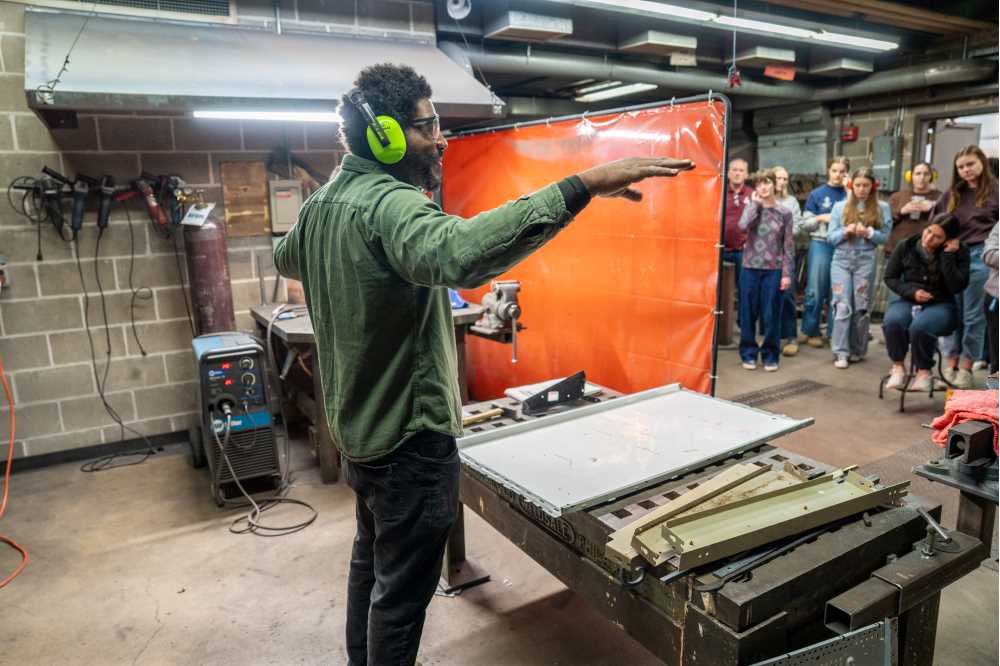
The visit was the result of a collaborative effort between the departments of Global Cultures and Languages and Art. Students, faculty and staff from multiple disciplines participated, creating a shared experience working directly with a contemporary working artist — asking questions, exploring materials, and seeing how ideas evolve in real time.
Méndez Páez’s work is rooted in sustainability and transformation. Using recycled and repurposed materials — often industrial or utilitarian in origin — he creates sculptural forms that carry both physical and symbolic weight. During his campus workshop, students saw this process firsthand, and the piece created during that session was later donated to UWL, leaving a lasting mark. The final sculpture was wholly representative of his aesthetic aspirations, passion, and richness of heart, says Doster. It was an improvisational creation that demonstrated metal fabrication techniques, yet the donated work of art was in no way perfunctory or merely an educational model, he adds.
He is an authority in multiple areas, as a native Spanish speaker, a Cuban citizen, and a highly accomplished, prolific professional artist,” says Doster. “In general, I think any international representative from another culture is an invaluable resource for young students, whose world experience may be quite limited.”
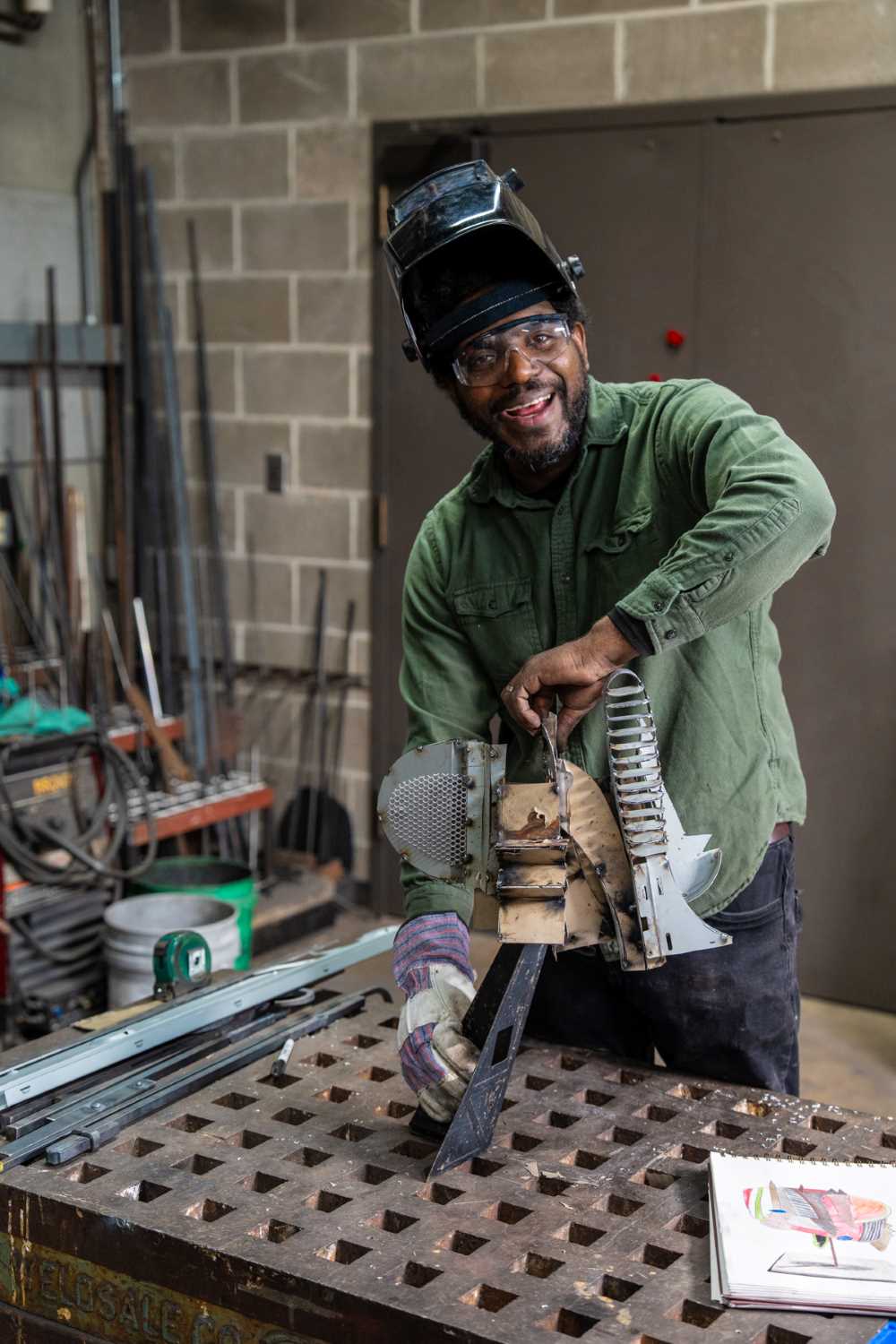
He was very approachable and his manner of engaging with the audience or individual student was pleasant, friendly and charismatic, says Doster.
A selection of his work is currently on display in a pop-up exhibition in the Dialogue Space outside the UWL Art Gallery in the Lowe Center for the Arts through April 20.
Born in Cuba and now based in the United States, Méndez Páez draws on personal and collective histories to explore themes of migration, displacement, labor and memory and the politics of place. His multidisciplinary practice spans sculpture, installation, drawing, and poetry, often weaving language into visual forms to deepen the narrative.
Funded by an Eagle Visiting Scholar/Artist grant, Méndez Páez’s visit reflects UWL’s commitment to bringing contemporary artists to campus — creating opportunities for students to learn not just about art, but directly from those shaping it today.