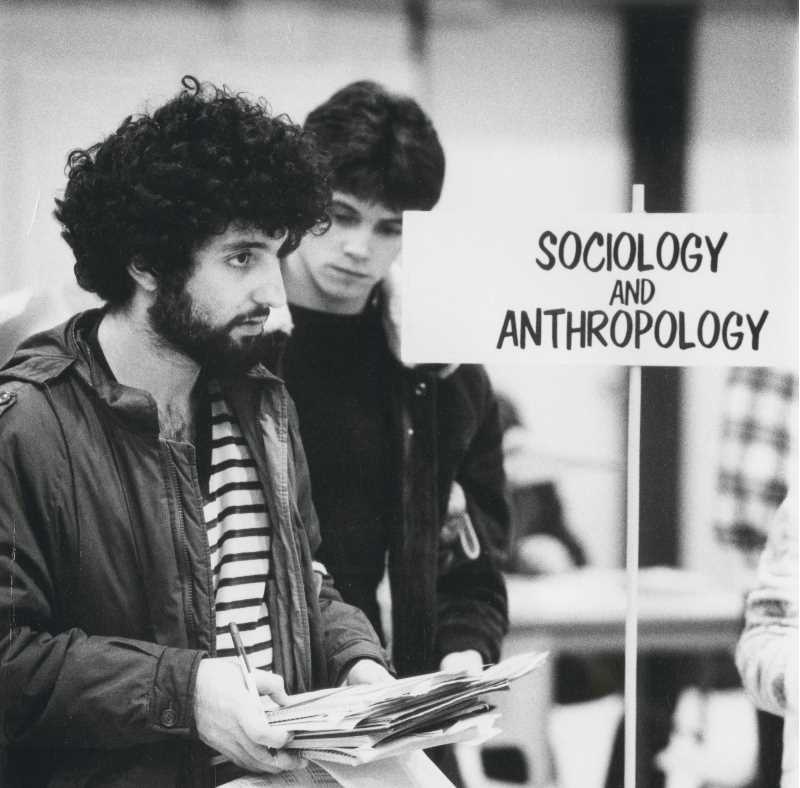



Registering For Classes
A page within Oral History Program
College Studentness: the living, working, social, and emotional conditions associated with being a college student at UW-La Crosse, from 1909 to the present day.
Technological Change & Registering for Classes
One of the coolest things about oral history is how it can help us understand how people’s memories about different subjects get bundled together. In the “College Life” project, we stumbled into a kind of evidence about prior generations’ experiences of college studentness that we hadn’t necessarily known we’d get from our pilot project interviews: stories about how registering for courses used to work in the 1970s - early 2000s. When we asked some interviewees who attended UWL in those years about the technological context (circumstances) they lived and studied in, conversations ultimately turned to two specific registration systems: the punchcard system (1967-1987) and telephone-based registration (1994-2004).
The twice-a-year ritual of course registration is an indelible part of the college experience. While the technologies associated with registration have changed over time, the stress associated with trying to get into required classes and building the perfect schedule around other commitments definitely unites college students across multiple generations. Since 2004 UWL has used online registration systems (TALON from 2004 - 2009 and WINGS 2009 - present). For 21st century students, growing up with technologies like WINGS can make it challenging to imagine how previous generations of students registered in a world before online-based registration systems. In this post, we’re featuring interviews from the “College Life” oral history project that include the interviewee’s experiences with older forms of registration.
How did Students Register for Classes ca. 1967-1987?
The Card System
Several “College Life” interviewees described the notorious process of collecting cards from tables in Mitchell Hall to build a schedule. As you listen to Mike and Peter, notice how discussions of the technological context for college students in the 1970s-1980s leads them into an explanation of the punchcard registration system. One additional facet of their explanations that’s also echoed by Harry: the importance of various kinds of personal connections and loopholes students might be able to use to get a card ahead of time. Knowing a sophomore, junior, or senior, or volunteering to help on registration day could earn someone a much needed course card?
Mike (first year: 1977)
Clip Length: 2:44
Transcript
Mike: Well, we were definitely before computers. I mean I still remember when we registered for classes, we had a certain time you went to Mitchell Hall and every department had a representative who had cards. And if that class was still open that meant there was cards on the table for that class. And so, you went around and say I need a Math, you know, 111 card and…if there was a card left, you were in the class. You turned those in at the end of [the] registration line so to speak. And if there were not, you had to scramble and what else was open. And so there was a lot of walking back and forth. You didn't get on a computer and do any of this. Your classes, I mean, if you had to turn a paper in, you had to have a typewriter and you typed your paper. There were a couple little word processors that were coming through at the very end, but that was still not the way things were done. So we did have some classes where they—you could actually be on campus, and there was a tv station, so to speak, that you could watch the lecture. But there was no interaction. The professor had no idea if you were watching or not watching. I mean, but you could watch a lecture. But that was only in a very few different classes you did that. But other than that, you had to be in class if you were gonna learn. You had to be there, there was no online notes. There was—you had to take your own notes and hang on to them, and teachers didn’t give you a whole heck of a lot of things. Here's your book, and better have a notepad, and be ready to go. So, very different time.
Tiffany: Sounds like. And I’m so glad that you explained the card system…for registration. There are—in the UWL Archives, there are some photos of like those rooms and that day, but hearing someone actually explain what it was like makes a big difference. Because otherwise, yeah, it’s just photos of people with like—I think one of them was like has this Sociology placard or something like that. And it’s like “what are they doing?”
Mike: One of the best jobs to have though, is you volunteered to help with that day. Because anybody who helped—whatever students were helping that day—had first dibs on registration. And so, no matter what year you were you could walk around and go grab cards. And so, needless to say, I did that a couple times.
Peter (first year: 1984)
Clip Length: 3:24
Transcript
Peter: Yeah. I had worked some late nights at Lindy's because it was also the bar. But I don't know, I never really had issues getting up for that. For the next morning classes. And I didn't have as many morning classes back then, because I had all 5 days to schedule my classes. Also getting your classes was different back then, which was probably the biggest change that you don't even realize right now. How we use it to get our classes. RIC, or whatever I don't know where they called it. But back then they would have each class with a bunch of like you don't even know what a library card is. But the little cards in the old basement, the card that this would be a class. I, once you get your car. and it was just so hard, because sometimes students would, you know, somehow get a couple of extra cards and give it to their friends. And then, you know. So you get yourself in a waiting list. So back then, to get class you want. You really had to go and talk to the professor and explain to them why you are looking to get in their class. And hopefully they would let you in. Where now, with everything being electronic, it sort of takes away that that entity because a lot of people that were working that were students. So there was a lot of you know. I'll get you. I'll get you that class or whatever. So it took. It took that away. So you know, getting classes is just based on where you stand with your credits. You get your classes first, I mean, that's taken into consideration. Where back, then it was. It was much more difficult. You know I need this class to be full time. I need this so I can't. All right, then. I'm just going to take this class so I’m full time. There was much more of that back then.
Brenna: Yeah, no, I I definitely didn't realize that that's crazy. Did they have like specific times for you to go in and take those cards, or was it kind of just like a free for all?
Peter: It was specific times. Some of the fall athletes did that before we even got there. So they were, you know they were set. And I think that was another group that was pulling cards for people later. But it was based on. You know how many credits you have. That the more credits you have the earlier you've got to go.
Brenna: Yeah, that's crazy. I know that a lot of like me included a lot of students now like still struggle with getting the classes that they need, but I, that system making it even harder for sure. With having other people involved, that's crazy. So then, did that, I guess, ever play a role into you, not being able to like graduate when you wanted to? Or did it ever have like a impact on your education?
Peter: Yeah, I mean, that had a little bit of it, I mean, because I was. I was in school for 6 years before I graduated. More so would be changing majors or being undecided. You know, I wasted, I wasted classes for different majors.
Harry (first year: 1985)
Clip Length: 1:58
Transcript
Harry: as you know, I was here before computers set in. And you had to go to I –it must have been at Cartwright [Center]. You had to go to Cartwright [Center], and stand in line and pull cards of, what do they call those? The computer cards, but there’s a name for them. You had to pull the card for the class that you wanted, you had to stand in line. And you set your schedule with your counselor if I remember how it worked right. You set your schedule, but you had to go get that class and if the cards were out, you were out, that was it, you didn’t get that class, you had to come up with something else. And you stood in line and every class had somebody behind the table with a sign up that said, you know, English 101, and you had to stand in line, pull the card and you hoped, I don’t remember if you could say I want this professor or you just got that card, I don’t remember that part. But it was like terrifying, and then I do remember this. The first time I had to do that, I didn’t know like the whole process. And kids were like getting upperclassmen at the time to pull cards for them, cause they went first. So, you could tell someone. You had a time slot, or I’m pretty sure you had a time slot, and you had to go to Cartwright [Center] at this time. So, if somebody had a time slot before you, and say you wanted some class that filled up quickly, you asked him to pull the card cause nobody checked your schedule if I remember you just pulled the card. And just as a side note if you ever watch Back to School, which is a terrible movie, by Rodney Dangerfield, he is at the University of Wisconsin doing the card pull. There is a scene where they’re all in the room and they’re doing that, they’re pulling cards. Cause it’s actually filmed at Madison. So, so if you ever want to see what that looks like. But it was, after the first time, it was kind of fun cause then you were there with all your friends, and everybody was just there and you would get your books at the [same] time.
Wayne (first year: 1973)
Clip Length: 2:57
Transcript
Gavin: Can you walk me through the process that you would go to sign up for classes?
Wayne: Well our process was to go over to—and I believe it was at Mitchell [Hall], I don’t think it was at [Graff] Main Hall, but I think it was at Mitchell [Hall]—and they would have these screens up on the wall and they would have all the classes that you were required to take, and then they would have the professors who were available, and then the times. And then you would fill out your—I think it was a Form Eleven it was called at the time. And then you would take it to a person at the desk, someone that would be, you know, responsible for you and so many students. And then if the teacher was still available and they hadn’t scratched his name off, and it wasn’t full, you would get that class at that time. And then you’d go to the second one and sometimes we’d have to go back and change because the class would fill up. Especially the basic classes that all freshman, sophomores, had to take would fill up quite quickly. And the professors that were real popular [Barrett snaps his fingers], they would go very quickly as well. Yeah. And we were a little disappointed sometimes when we would get a time that we didn’t like or a professor that we didn’t know, or we weren’t able to get the one that everybody told us “you should take that person.” But it all seemed to work out. Today I think they just—and I think late in our career—they basically just, you just fill out the classes you needed and then they picked the time and the professor, you didn’t have that choice.
Gavin: Oh, really?
Wayne: Yeah.
Gavin: That was in your last year?
Wayne: The last part of college. Yeah.
Gavin: Well, that’s just probably more ‘cause you needed to get them done?
Wayne: I think so, yeah.
Gavin: So how early were your classes then?
Wayne: Well, I had classes at eight, nine o’clock in the morning, ten o’clock. I always liked taking a class on Wednesday night. It kind of took that week and gave you a little bit of extra time during the day. We’d have a class usually from six thirty to nine thirty, three credits. And I usually took sixteen, seventeen, eighteen credits. And it just seemed like that Wednesday night was a time when you could, you know, middle of the week, you weren’t too too busy yet, and it left the rest of the day where Monday, Tuesday, Wednesday, Thursday, Friday you had a little bit less time because you had three credits taken up on Wednesday night. I didn’t care for eight o’clock in the morning classes [Stebbins laughs]. But today it wouldn’t be a problem. But in college, you know, eight o’clock seems early and I didn’t like taking three, four o’clock in the afternoon classes. It just seemed like your day should be done by then. But I had ‘em too.
Butch (first year: 1961)
Clip Length: 2:25
Transcript
Gavin: Ok. And then, what was the process that you went through when you needed to register for classes?
Butch: We had, we went to, we had these punch cards and we would, they would set up tables with a certain, I don’t know if it was the professor or just somebody working, like if you, you had a list of what you could choose from and let’s say I wanted to take English literature, I would go to that table and pick up a card. And there were times when, if a class got filled up, then you were rejected and had to choose another option, but I don’t think that happened very often with me. I can’t recall. I think pretty much I was able to get what I wanted each semester.
Gavin: And…
Butch: And it could be, and especially with the Speech department, there were so few people in that department, or students…
Gavin: Yeah.
Butch: …in that department that it wasn’t difficult to get a class.
Gavin: And where was this class registration done?
Butch: You know, I think it was in that Murphy building later on.
Gavin: Mitchell Hall?
Butch: Or Mitchell Hall, right yeah, Mitchell Hall probably. I don’t know if that was all the time.* It was you would go where there was a large room, like a gym type of thing.
Gavin: Yes.
Butch: That’s where all the tables were set up. Well I, you know, its recalling things that I’ve forgotten 60 years ago.
Gavin: And then, today’s students have access to websites such as RateMyProfessor that allow you to find professors that other students have, sort of, rated quite highly and you want to get into their classes. Was there a way that you would know which professors were good and you’d want to have their class?
Butch: Not that I know of. There could have been, but I imagine it was more maybe word of mouth or student talking to student about a class and, of course, since I wasn’t real social I didn’t get in on that.
Gavin: Yeah.
Butch: So I just accepted whoever, whatever class I wanted, whoever was teaching it was fine with me.
Gavin: And you didn’t really have any difficulties doing that?
Butch: No.
*Before the construction of Mitchell Hall in 1965, students registered for classes in the Florence Wing Library (now called the Wing Technology Center).
Because OHP’s present-day staff is not familiar with the inner workings of the punchard registration system, we did some additional digging using primary sources available in Murphy Library’s Digital Collections. Turns out it was not just the “College life” interviewees who found loopholes. Other students frequently wrote articles in the UWL Campus Newspaper, The Racquet, sharing their experience with in-person registration and tips for hacking the system. In a January 20, 1983 commentary published in The Racquet, Kevan Kavanaugh explained that two kinds of people might be relied on to acquire a much-needed card for a course. “For a small fee - a six pack of beer, perhaps – you can have an upperclassman pull your cards for you.” A second option, which might be more daunting, was to approach the course’s instructor, who might “have at least one or two class cards in his desk. With a good sob story, a little sweet talking, and some pleading on your hands and knees, most instructors will surrender you a card if they don’t ha[t]e your guts” (p.9) You can read Kevan's entire article here.
Phone Registration as a Transitional Period Between In-Person and Online Registration
Another “College Life” interviewee, Karolyn, helps us understand the new technology that replaced the punchard system in 1994. The “touch-tone” registration system involved using a landline telephone (standard in each dorm room) to sign up for classes. At their appointed time, students made a phone call, and when prompted they typed in numerical codes for the courses they wanted to enroll in. One hypothesis is that this new system improved the integrity of the system (no more bribing students who registered earlier to steal cards for other people). But it also presented new complications (trying to make early morning phone calls while a roommate was sleeping). Karolyn explains what it was like to use this phone-based registration system and how students' views on registration have changed with the creation of online registration systems.
Karolyn (first year: 1993)
Clip Length: 5:29
Transcript
Karolyn: So we had, one of us had a TV, and a microwave. Well you know what, the microwave I’m not even sure, we must have. But I remember having like a hot pot that I could boil water in and I would make ramen in it, when I would get tired of Whitney [Dining Center]. But, you know, we spent a lot of time at Whitney [Dining Center]. Also, Whitney [Dining Center] was where like our source of where we’d go eat but it was also a social hour. So you know we would all plan to go together and walk together and so forth. But, no computers. There might have been two or three computers in the basement of the building. But you had to go to the front desk and get a key, and check out a key to go downstairs to use a computer. So a lot of us had typewriters and it was like a really big deal if you got a typewriter that had some memory in it. So you like didn’t necessarily have to type each letter you could type like a few sentences. And then when you were good, you could press you know return or whatever and then it would type that. And if you had that, I mean you were kind of big time if you had that. But there was still a lot of paper, pencil. And we had a phone. Every room had its own phone because of course we didn’t have cell phones. And I remember [course] registration time. You got a registration time, and it might have been like May 1st. Well phones opened at 5:00 [am] so everyone was up at—I don't remember if it was 5:00 [am] something like that—but you were up at like 4:30 [am], ready to go, and you would start dialing probably about five minutes ‘til and you would just keep redialing until you got through. And so there was no specific time that you had to call in. It was just that was your day so everyone was up, like before the sun was up, like redial, redial, redial until you got through hoping you would get the classes you want. And so if your roommate was sleeping, you hoped that your phone had a long enough cord you could do it in the hallway. Otherwise, you were going to have to bribe your roommate or figure out a way to pay them back for disrupting their much-needed sleep that we all need in college.
Tiffany: So, if I can ask follow up questions about this. We’ve had a few folks [as interviewees] who were here in the [19]70s or the early [19]80s who talked about the registration process that was where you went into the room and you got the punch cards. So in your experience, you called and you had to like—did you talk to a person or did you like punch in numbers? Or how did it work?
Karolyn: No, I’m trying to remember. I mean I came—like I remember people saying “oh, remember when we had to stand in line in Mitchell Hall?” And we didn’t have to do that, so like we were kind of high tech. I don’t remember a person, but then again you know it was like 5 o-clock in the morning and it was thirty years ago so I’m not really sure. But I think for the most part, I just remember punching in numbers.
Tiffany: Okay. That’s amazing.
Karolyn: Yeah. I might be wrong on that. But, I just remember it being very stressful and then you would be like [Bald sighs], you could breath after you got done with it but then you were so amped up you couldn’t go back to sleep. So then you’d go to Whitney [Dining Center] super, super early.
Tiffany: How did you get confirmation? Like did you get like a print-out? Or like how did you find out that like what you had punched into the phone like eventually became your schedule?
Karolyn: I think it would tell you if it was accepted. So you would have an idea if it was accepted or not and so you had this long list of back-ups, in case you needed to quick pivot to a different class. And so like I love today how students will say “well I don’t want classes at 7:45 [am] or after 4:00 [pm].” I’m like “oh gosh, like we had the most random schedules back then because you took what you could get. And you know what? We survived.” [Bald laughs.] That’s what’s so funny sometimes when I hear students say “I just can’t do it.” I’m like “yeah you can. You can do it. You just don’t want to.” But yeah, it was a big deal. Registration was huge.
Tiffany: And that’s amazing. I’m so excited to have you tell that story because this is the first evidence we have of that piece of it [telephone-based registration process]. Like we had, you know, folks who were here in the 2010s talking about doing it online and folks who were using punch cards in the [19]70s and [19]80s, and so it's nice to fill in that next iteration of the technology.
Karolyn: Yeah, and I think as I got later in my college career you started to get times. Like they would do—and I can't remember if it was my college years or when I was working here—but you would get a time to call in so not everyone was like clogging up the lines trying to get through. But there were no cell phones and, you hoped you had a long enough cord or you might’ve had a, remote—what do you call them? We don’t even have them anymore. But the cordless phones that you could just lay in bed and try to do it, so, yeah.
Can You Relate?
Registering for classes is an experience that all college students at one point in time are familiar with. In this blog post, we reviewed each registration type that interviewees in our College Life project discussed. The interviewee’s first-hand experiences helped paint the picture of what it was like to register for classes during the card system and phone registration. How do your registration experiences relate or differ from the ones you heard from the interviewees?
How Alumni Can Help
OHP definitely views our work as a collaborative effort. There are three distinct ways former college students at UWL can help the “College Life: What We Remember” project.
- Share what you remember by participating in an oral history interview. History continuously evolves as more information is brought to light. Our “College Life: What We Remember” oral history project is in its early stages: right now we only have 15 interviews. In Fall 2024 and Spring 2025 we’ll be conducting another round of interviews. Do you have memories about your college years at UWL you’d be willing to share with our project? We’re hoping to learn more about multiple aspects of college life. But as you can see from this blog post, we’re especially hoping to learn about what alumni remember about their process of registering for classes. If you’re interested in participating in an oral history interview, please fill out this online survey to let us know. You can also contact us at oralhistory@uwlax.edu to find out more about the “College Life” oral history project.
- Provide additional kinds of primary source evidence. Does anyone still have any photographs or other materials showing registering for classes? If so, we’d love to see it! Please contact us at oralhistory@uwlax.edu.
- Make a financial donation to sustain our project. OHP relies on donations to fund our student internships and keep our oral history work going. You can make a gift online through this link: Donate to OHP.
Production credits: writing by Shaylin Crack, Julia Milne, and Tiffany Trimmer, research and conceptualization by Shaylin Crack and Julia Milne, web design by Olivia Steil, collection processing by Shaylin Crack, Julia Milne, Isaac Wegner.
Our Social Media