Posted 1 p.m. Wednesday, Jan. 14, 2026
Conservation Biology students partner with community to restore crucial habitats
Prairies are one of the most endangered ecosystems in North America — under constant pressure from agricultural sprawl, invasive species and other environmental factors.
But students in Jaspreet Kaur’s Conservation Biology course at UW-La Crosse have teamed up with local land stewardship groups to stave off these threats and restore pockets of prairie habitat in and around La Crosse.
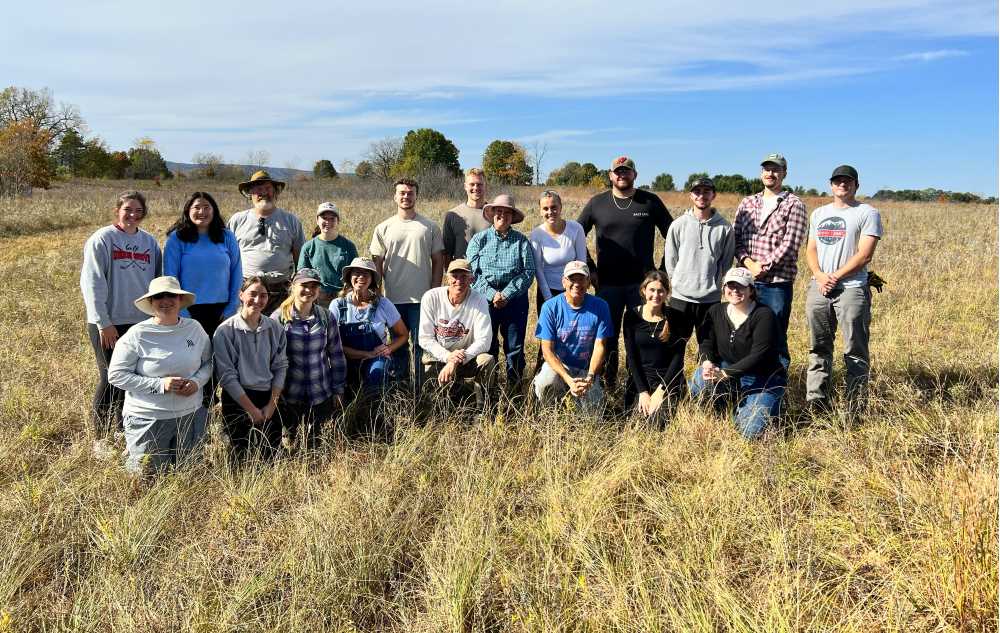
The class, working alongside the Prairie Enthusiasts and Friends of the Blufflands, spent several days in October rehabilitating sections of Lookout Prairie, Sand Holland Prairie and Stry Prairie — harnessing their classroom knowledge to help address a community problem.
“Being able to apply what I learned in my Conservation Biology course, and directly contribute to that conservation and restoration in this project, gave me a firsthand experience of why bluffland prairies are so important to the ecosystem,” says Josh Orner, a senior biology major. “By actively participating in the restorations of these prairies, we provide habitat for a multitude of different species — including birds, snakes and insects — that rely on the native prairie grasses and forbs we are actively restoring.”
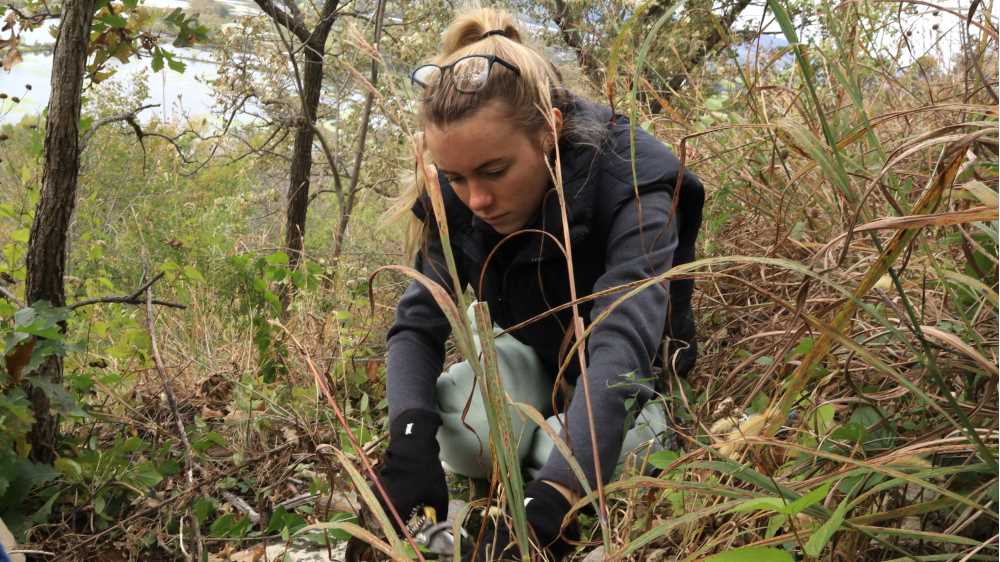
Part of UWL’s Community Engaged Learning program — in which students partner with local organizations to apply their learning to a community project — the course demonstrated for students the hands-on, rewarding nature of conservation work. Students were called on to get their hands dirty, collecting and dispersing native prairie plant seeds, and chopping back invasive species such as buckthorn.
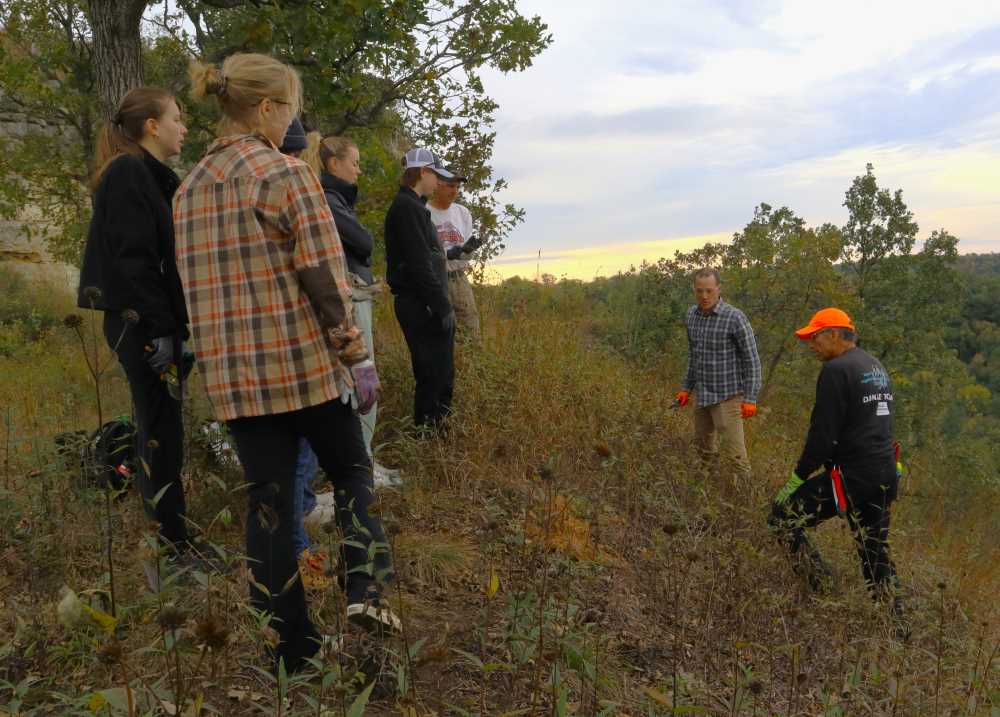
“Working on this conservation project has helped me see how hands-on fieldwork deepens both my understanding of biology and my appreciation for the environment,” says Natalia Stadler, a junior biology major. “Seeing the restoration efforts at Lookout Prairie and learning how much of the original prairie landscape has disappeared over the last century made me more aware of the importance of active stewardship in protecting biodiversity."
Every inch of restored habitat serves to reverse a troubling, longstanding trend: In the United States, less than 1% of native prairies remain as they were in the centuries before European settlement and extensive agricultural development.
Locally, some prairie habitat has been nursed back to health, but much work remains.
“The most impactful thing I’ve learned over this project ... is how much volunteer work can change an environment,” says Madison Wall, a senior biology major. “Seeing pictures of La Crosse’s prairies from the late 1900s and what they look like now is incredible. It was amazing seeing how much prairie habitats have recovered because of volunteer organizations.”
Why is it important to preserve these ecosystems? Prairies offer myriad ecological benefits as hosts to a variety of plants, insects, birds and mammals that would struggle to survive elsewhere, Kaur says.
A specialist in orchid conservation, Kaur cites the Western Prairie Fringed Orchid and the Eastern Prairie Fringed Orchid as examples of plants that depend on prairie habitats. Prairies support populations of pollinators on which plants — and by extension, other organisms in the food chain — rely.
Losing prairies also means losing a piece of the past.
“Remnants are all that remain of the vast prairies and savannas that once covered the area,” says Jim Rogala, president of the Prairie Enthusiasts. “One prairie was an ancient floodplain terrace sand prairie that historically stretched from La Crosse to the north along the Mississippi River. The other sites were bluff prairies that give us a glimpse of what most of our bluffs looked like prior to European settlement.”
Thanks to this partnership, the next generation of conservationists is getting a crash course in environmental restoration — whether they ultimately choose to pursue it as a career, or as a passion project through volunteering.
An assessment completed by Kaur’s class showed that many students were previously unaware of community-based conservation initiatives, and that the project equipped them with skills and perspectives supporting their professional development.
“These experiences directly align with career and volunteer opportunities in environmental science and natural resource management,” Kaur says. “Many students in the course were from environmental science or related fields, and the skills gained — such as invasive species management, seed collection, habitat restoration and collaboration with conservation professionals — are highly applicable to (the workforce).”