The human factor
Kevin Zabel combines a knack for mentorship and a fascination with social psychology
Kevin Zabel's research explores the social factors that shape human psychology and behavior — a subject he brings to life for students through teaching and research mentorship.
Posted 4 p.m. Monday, Nov. 16, 2026
Understanding people is Kevin Zabel's profession and passion.
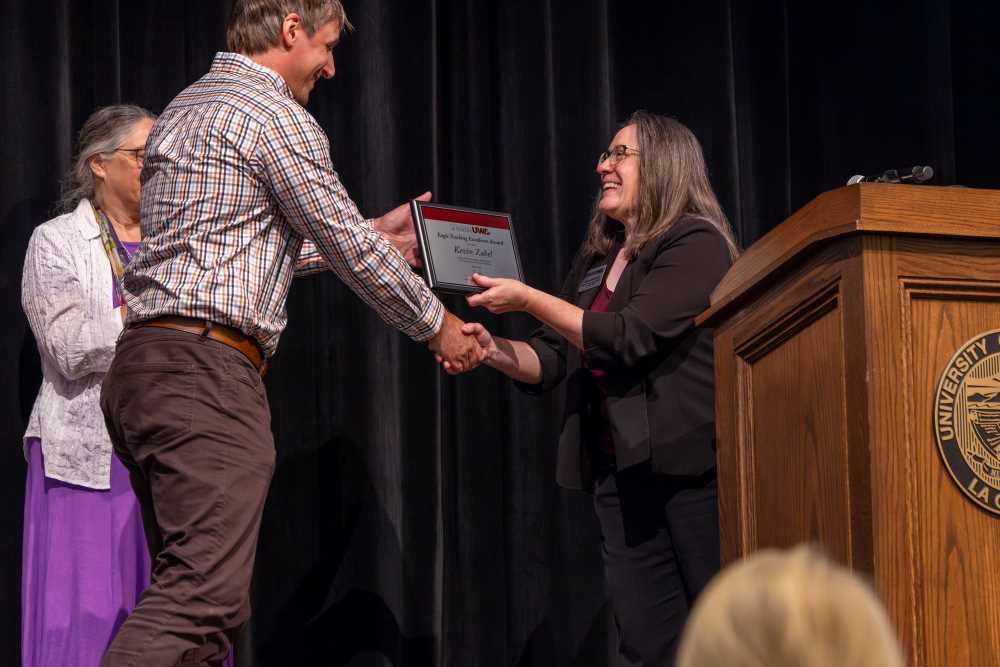
The UWL associate professor of psychology, who received an Eagle Teaching Excellence Award earlier this year, explores how social forces shape human behavior while helping students discover those insights for themselves.
As the fall semester enters the home stretch, Zabel took a moment to share his path into the world of psychology, the joy of mentoring student researchers and the ways UWL supports growth and curiosity.
Q: What first sparked your interest in psychology? When did you decide on that career path?
A: I was originally a psychology minor and business and economics major at Albion College in Michigan. I completed a semester-long internship in Chicago pertaining to business. Although it was a good experience, I realized that I wanted to focus on developing a career in psychology instead. My senior year at Albion College, I started conducting research under the mentorship of Drew Christopher in the Psychology Department. I found the opportunity to design my own research study, collecting data, analyzing data and presenting research to be invigorating. I found myself devoting time to these pursuits voluntarily and for the first time really started to get a sense of what the future could look like in terms of a career.
After graduation, I took a gap year and worked for one year in Chicago as an apprentice at the Chicago Center for Urban Life and Culture under the leadership of Scott Chesebro, helping to facilitate experiential learning opportunities to students in social work, education, and beyond in Chicago. It was in this role that I developed a passion for social psychology specifically. My graduate mentor Michael Olson played an important role in further developing my passion for research, while enabling me to notice at the same time my appreciation and love of teaching.
Overall, Drew, Scott and Michael encouraged me to develop my skills and pursue my curiosities and interests in a manner that led me to develop a passion for social psychology and teaching. I am forever grateful to them.
Q: What is it about social psychology in particular that appeals to you?
A: Relative to other sub-disciplines in psychology, social psychology especially emphasizes how environmental factors can overwhelm us as individuals and lead us to engage in behaviors inconsistent with our individual goals, values or beliefs. I have fundamentally always found that fascinating. Social psychology also appreciates the importance of the individual and what they bring to the situation as more stable personality variables, such that elements of both the "person" and "situation" are important to impact an individual's feelings, thoughts and actions. More broadly, I have appreciated how social psychology tends to focus on psychological processes that unite us as human beings (e.g., the need to connect with others). I have always found that to be humanizing and an effective angle to approach important contemporary challenges.
Q: What drew you to the opportunity to teach at UWL?
A: There are lots of opportunities at UWL for both faculty and students. For instance, I was very impressed initially by support regarding research endeavors and faculty development. Moreover, there are many organizations for students to connect with others and share similar interests and goals, research grant opportunities for students, and plentiful internship opportunities for students at many local organizations. I also especially appreciate UWL's emphasis on supporting engaging student recreational opportunities in a manner consistent with our institution's mens corpusque (mind and body) educational philosophy.
Q: You're heavily involved in research projects with undergraduate students. What do you enjoy about engaging with students on research? Do any examples stand out?
A: There are so many examples here. I wish I could elaborate more on each student I have worked with in research! One student that comes to mind is Lexi Krueger. I first met Lexi when she was a student in my first-year seminar class. She ended up working with me as an Eagle Apprentice and developed her own research study from the ground up, examining factors that influence whether a person will seek help for someone who has disclosed suicidal ideation to them. She designed her study, collected data from hundreds of participants, and presented her data in poster and verbal formats at regional and national conferences. It was truly a joy to see her grow in her passion for psychology and research skills and to get to know Lexi more as a person. We are currently working on preparing a manuscript to submit for peer-review publication.
Another example that comes to mind is research conducted by Kelsi Bellisle and Juliet Lor on first-generation college students and motivation to pursue a future advanced graduate-level degree. Both students genuinely engaged in the process of conducting research and went above and beyond when it came to drafting sections of the paper and collecting data. Both Kelsi and Juliet are currently enrolled in graduate-degree programs. I know from my conversations with them that engaging in research was important to their growth as students and next steps when it came to graduate school applications and success. We have completed a manuscript for publication pertaining to their research and will soon submit that for peer-review.
Q: What has the College of Arts, Social Sciences & Humanities (CASSH) done to support your research interests?
A: CAASH has been supportive and encouraging when it comes to laboratory space, as well as generous in supporting my students and myself regarding conference travel expenses. I have always found CASSH to be supportive of our work and the development and growth of our students.
Q: What do you enjoy about the teaching and learning environment at UWL?
A: I find the students at UWL to be hard-working, conscientious and curious. I find that students are curious about each other and supportive of each other inside the classroom and outside the classroom. It always strikes me how much we all depend on each other as a UWL community when it comes to seeing students in my courses caring for children at the Campus Child Center or seeing members of the Screaming Eagles Marching Band put on performances for the campus community or the Psychology Club facilitating events that allow students to learn more about the department and careers in psychology, just to name a few. These examples all make me appreciative to be a member of the UWL community.
Q: What are your interests outside of teaching?
A: Most of my time outside of teaching is focused on spending time with my wife, Barbara, and three children (Ingrid, Linden and Greta). We like to take advantage of all the outdoor activities and opportunities La Crosse and the Driftless Region have to offer.