


Accessibility menu

Skip to main content Skip to footer

Profile for Dean Vesperman
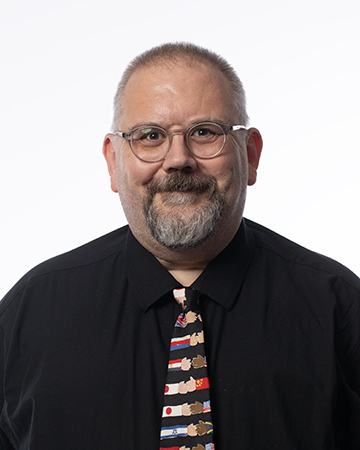
Dean Vesperman profile photo

Contact me

Dean Vesperman

Pronouns: He, Him, His
Assistant Professor
History
University of Wisconsin-La Crosse

FirstGeneration badge
FriendlyFace badge
SOEFaculty badge
AdvisorCertification badge

Dean Vesperman Pronouns: He, Him, His

Assistant Professor

History

Specialty area(s)

Citizenship and democracy education 

Cultural-Historical Activity Theory

Education Policy

Brief biography

Dr. Dean P. Vesperman is an assistant professor of education in the History Department at the University of Wisconsin-La Crosse. Dr. Vesperman teaches courses in secondary social studies methods. He earned his doctorate at Indiana University in Curriculum and Instruction minor in learning sciences. Before earning his doctorate Dean taught junior high and high school social studies for eleven years in southeastern Wisconsin and CTY for 18 summers. Dr. Vesperman has published articles on various pedagogical methods for teaching social studies. He lives in Western Wisconsin with his wife, daughter, and dog

Current courses at UWL

HIS 419  - Teaching and Learning Social Studies in the Secondary School and Field Experience II

Education

BS - University of Wisconsin-Oshkosh - History and International Studies

MEE - Cardinal Stritch University - Brain-Based Teaching and Learning 

Ph.D. - Indiana University - Curriculum and Instruction: Curriculum Studies and Learning Sciences

Career

Teaching history

I taught middle and high school social studies for 11 years. I taught 7th Grade World Geography, 8th Grade United States History to 1877, High School courses in American Government, Economics, Psychology, and Sociology, and Film Analysis. 

I have taught classes in elementary and secondary social studies methods, educational psychology, foundations of diversity and equity, and education policy. 

Professional history

Luther College - 2014-2019

University of Wisconsin-River Falls - 2019-2024

Research and publishing

Blankenship, W. G., Aydinian-Perry, A., Vesperman, D. P., & Missias, M.T. (2025). Contextualizing socio-cultural STEM through historical figures and events. In Pryor C. R. and Kang, R. Socio-Cultural STEM for middle school: A model for student engagement and teacher collaboration (pp. 81-105). Rowan & Littlefield.

Aydinian-Perry, A., Missias, M. T., Blankenship, W. G., & Vesperman, D. P., & (2024). Teaching the Red Summer Through The Chicago Race Riot: A Primary Source Investigation.  Oregon Journal for the Social Studies 12(1). p. 14-25.   


Smith H., Vesperman, D. P., Frederick, A. (2024). Preparing Teachers for Linguistically Diverse Classrooms. In Andrews, O. S. & Tomlin, A. D. When We Hear Them: Tools to Attune Teachers’ Ears to Voices of Language-Diverse Learners. Information Age Publishing. 257-267.  


Aydinian-Perry, A., Missias, M.T., Vesperman, D. P., & Blankenship, W. G. (2024). Whose greatest story is ever told: Historical agency in evangelical Christian American history textbooks. In Allen, A., Kavanagh, A. M., and Ni Cassaithe, C. Moving Beyond a Single Story. Information Age Publishing. 195-213.


Vesperman, D. P., Aydinian-Perry, A., Blankenship, W. G., & Missias, M. T. (2023). Acknowledgements and introduction. In Vesperman, D. P., Aydinian-Perry, A., Blankenship, W. G., & Missias, M. T. Out of turmoil. Catalysts for re-learning, re-teaching, re-imagining history and social studies. Information Age Publishing. Xi-xiii.


Vesperman, D. P. & Pol, M. (2023). Teaching social studies in a time of COVID-19: an examination of contradictions in activity. In Vesperman, D. P., Aydinian-Perry, A., Blankenship, W. G., & Missias, M. T. Out of turmoil. Catalysts for re-learning, re-teaching, re-imagining history and social studies. Information Age Publishing. 57-72. 
Kudos

published

Dean Vesperman, History, authored the chapter "“But now I see that there’s so much more to it: Journaling, primary contradictions, and expanding conceptions of democracy and citizenship." in "Social Science Education for Just and Sustainable Societies," which was accepted for publication by Emerald Publishing.

A goal of sustainable development is the promotion and creation of a peaceful and inclusive society. Thus, this requires citizens who are committed to these basic principles, enshrined in democratic institutions. Given the central role of schools in the creation of democratic citizens, (Parker 1996; Westheimer & Kahne 2004), this study explores how preservice social studies teachers expanded their conceptions of citizenship and democracy in relation to the goals of the SDGs. This study demonstrates that journaling about democracy creates primary contradictions (Engeström 1987; 1990), which leads to an expansion of their conceptions. Therefore, teachers could and should use journaling as a means for students to explore various aspects of how peaceful and inclusive societies support sustainable development.

Submitted on: June 8

presented

Dean Vesperman, History, presented "The benefits of NCSS" at Teacher Network Night: Engaging in Professional Organizations" on Monday, May 11 online. Vesperman was invited to participate on a panel of experts from ACTFL and NCTM about the importance of joining professional organizations for new teachers. He presented on the benefits that he and his teacher candidates have received from being members of NCSS and discussed joining state-level teacher organizations such as WCSS and the Oklahoma Council for the Social Studies.

Submitted on: May 10

presented

Dean Vesperman, History, presented "Using political simulations to examine policy implications in addressing climate change" at Climate and Coffee on Friday, April 24 in La Crosse, WI. How do you get students engaged in active deliberation of climate change? This presentation addressed two simulations (COP of the UNFCCC and Arctic Council), which engage in deliberative role-play about the issue of climate change.

Submitted on: April 24

presented

Abrielle Klawitter, Audrey Langworthy and Dean Vesperman, all History students, presented "Improving the Rigor of AI-Gen Curriculum: Mastering the Machine" at Wisconsin Council of the Social Studies on March 13 in Madison, WI. This session begins with a short overview, giving historical context for the AI-generated lessons. Next, discuss the generative AI curriculum and the various generative AI engines that were used to generate the curriculum. This includes what each tool created and the limitations of each AI engine. Then, participants will work through stations examining lesson plans created with various generative AI engines.

Submitted on: Mar. 14

presented

Terra Clark, Abrielle Klawitter, history students, and Dean Vesperman, assistant professor of history, presented "Machine Learning Meets History: Improving the Rigor in AI Lesson Plans" at National Council for the Social Studies on Dec. 6 in Washington D.C. This session for teachers shared how to use various learning theories to improve the rigor of AI-generated lessons. We introduced a sample of the 30 AI-Gen lessons created for teaching the Kerner Commission Report. We then guided teachers in analyzing the sample lessons using Bloom's Cognitive Taxonomy, Gardner's Frames of Mind (multiple intelligences), and Newman's Authentic Intellectual Work. Once the learning theory analysis revealed gaps in the lesson, we discussed how to improve the rigor of the lessons.

Submitted on: Dec. 8, 2025

Memberships & affiliations

[{"organization":"SSEC","position":"President-ex officio","url":"https://ssec-inc.org/"},{"organization":"WCSS","position":"Chair Higher Education Committee","url":"https://www.wcsswi.org/"},{"organization":"NCSS","position":"Chair of Assignments Committee","url":"https://www.socialstudies.org/"}]