Professional history
Professor (2016 - )
Associate Professor (2011 - 2016)
Assistant Professor (2008 - 2011)
Research and publishing
Carpenter, C. J., Serota, K. B., Docan-Morgan, T., & Levine, T. (2025). Validation of an efficacy of lying scale. Communication Research Reports. Advance online publication. DOI: https://doi.org/10.1080/08824096.2025.2530459
Serota, K. B., Levine, T. R., Zvi, L., Markowitz, D. M., Docan-Morgan, T. (2024). The ubiquity of long-tail lie distributions: Seven studies from five continents. Journal of Communication, 74(1), 1-11. DOI: 10.1093/joc/jqad040
Carpenter, C. J., Levine, T., Serota, K. B., Docan-Morgan, T. (2022). Influence and personality: Relationships among superdiffuser traits and big five traits. Communication Quarterly, 70(1), 63-83. DOI: 10.1080/01463373.2021.2021260 (link)
Serota, K. B., Levine, T. R., & Docan-Morgan, T. (2021). Unpacking variation in lie prevalence: Prolific liars, bad lie days, or both? Communication Monographs, 89(3) 307-331. DOI: 10.1080/03637751.2021.1985153 (link)
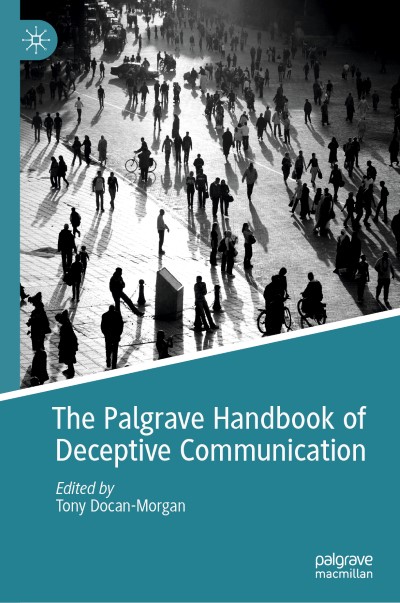
Docan-Morgan, T. (Ed.) (2019). The Palgrave Handbook of Deceptive Communication. New York: Palgrave Macmillan. (link)
Kalbfleisch, P. J., & Docan-Morgan, T. (2019). Defining truthfulness, deception, and related concepts. In T. Docan-Morgan, The Palgrave Handbook of Deceptive Communication (pp. 29-39). New York: Palgrave Macmillan. (link)
Docan-Morgan, T., Son, S. A., & Teimouri, G. B. (2019). Propaganda, survival, and living to tell the truth: An analysis of North Korean refugee memoirs. In T. Docan-Morgan, The Palgrave Handbook of Deceptive Communication (pp. 989-1023). New York: Palgrave Macmillan. (link)
Docan-Morgan, T. (2018). Review of "Every Falling Star: The True Story of How I Survived and Escaped North Korea" by Sungju Lee. North Korean Review, 41(1), 120-122. (link)
Docan-Morgan, T. (2018). Review of "North Korea's Hidden Revolution: How the Information Underground is Transforming a Closed Society" by Jieun Baek. Korean Studies, 42, 94-96. (link)
Docan-Morgan, T. (2017). Observational measurement: Proxemics and Touch. In M. Allen, The SAGE Encyclopedia of Communication Research Methods (pp. 1109-1111). Thousand Oaks, CA: Sage Publications. (link)
Docan-Morgan, T. (2016). Teaching interpersonal communication online: Experiential opportunities and student engagement. Syllabus, 5(2), 1-15. (link)
Docan-Morgan, T., & Nelson, L. L. (2015). The benefits and necessity of public speaking education. In K. Vaidya (Ed.), Public speaking for the curious: Why study public speaking (pp. 1-16). Curious Academic Publishing. (link)
Docan-Morgan, T. (2015). The participation log: Assessing students’ classroom participation. Assessment Update: Progress, Practices, and Trends in Higher Education, 27(2), 6-7. (link)
Docan-Morgan, T. (2014). Mingling with students before class: What to ask. College Teaching, 62, 117. (link)
Docan-Morgan, T. (2014). The career assignment: Helping students find their way. Journal of Speech and Theatre Association of Missouri, 44, 83-86. (link)
Manusov, V. L., Docan-Morgan, T., Harvey, J. (2014). Nonverbal firsts: When nonverbal cues are the impetus of relational and personal change in romantic relationships. In A. Kostic & D. Chadee (Eds.), Social psychology of nonverbal communication (pp. 153-172). Palgrave Macmillan. (link)
Docan-Morgan, T., Huisman, D., Docan-Morgan, S. (2014). A “dynamic knot” of students: A classroom activity for teaching relational dialectics. Carolinas Communication Annual, 30, 102-106. (link)
Docan-Morgan, T. (2014). The nonverbal communication course: Active engagement in the classroom and online. Syllabus, 3, 1-17. (link)
Docan-Morgan, T., Manusov, V. L., & Harvey, J. (2013). When a small thing means so much: Nonverbal cues as turning points in relationships. Interpersona: An International Journal on Personal Relationships, 7, 110-124. (link)
Docan-Morgan, T. (2011). “Everything changed”: Relational turning point events in college teacher-student relationships from teachers’ perspectives. Communication Education, 60, 20-50. (link)
Docan-Morgan, T. (2010). Mindmapping and beyond: Teaching students to select and narrow communication research topics. Journal of Speech and Theatre Association of Missouri, 40, 145-151. (link)
Docan-Morgan, T. (2010). “You're a grounded theorist for the day”: Teaching students the grounded theory approach. Communication Teacher, 24, 203-207. (link)
Docan-Morgan, S., & Docan-Morgan, T. (2010). Compassion, moderation, and humility in interpersonal relationships. In D. Newton, W. Fong, & N. Van Leuven (Eds.), Communications for everyday life (pp. 89-112). Toronto: Ginger Post Imprints. (link)
Docan-Morgan, S., & Docan-Morgan, T. (2009). Compassion, moderation, and humility in interpersonal relationships. In N. Van Leuven & A. B. Chan (Eds.), The Dao of communication (pp. 97-121). Toronto: Ginger Post Imprints. (link)
Docan-Morgan, T., & Manusov, V. (2009). Relational turning point events and their outcomes in college teacher-student relationships from students’ perspectives. Communication Education, 58, 155-188. (link)
Docan-Morgan, T. (2009). A typology of relational turning point events in college teacher student relationships. Journal of Scholarship of Teaching and Learning, 9, 82-97. (link)
Docan-Morgan, T. (2009). “I now see how I can use these skills”: An applied project for the public speaking course. Communication Teacher, 23, 110-116. (link)
Docan-Morgan, T., & McDermott, V. (2009). Becoming a better listener: The listening log project. Journal of Speech and Theatre Association of Missouri, 39, 93-99. (link)
Docan-Morgan, T., & McDermott, V. (2009). The listening log assignment. In B. Hugenberg & L. Hugenberg (Eds.), Teaching ideas for the basic communication course 12 (pp. 175-182). Dubuque, IA: Great River Technologies. (link)
Docan-Morgan, T. (2008). Review of Infidelity: A Practitioner’s Guide to Working with Couples in Crisis edited by Paul R. Peluso. Journal of Loss and Trauma, 13, 481-484. (link)
Docan-Morgan, T., & Docan, C. A. (2007). Internet Infidelity Scale [Database record]. Retrieved from PsycTESTS. doi: 10.1037/t24758-000. (link)
Docan-Morgan, T., & Docan, C. A. (2007). Infidelity on the Internet: Double standards and the differing views of women and men. Communication Quarterly, 55, 317-342. (link)
Docan-Morgan, T. (2007). Training law enforcement officers to detect deception: A critique of previous research and framework for the future. Applied Psychology in Criminal Justice, 3, 143-171. (link)
Docan-Morgan, T. (2007). Writing and communicating instructional objectives. In B.
Hugenberg, L. Hugenberg, S. Morreale, D. Worley, & D. Worley (Eds.), Basic communication course best practices: A training manual for instructors (pp. 25-41). Dubuque, IA: Kendall/Hunt Publishing Company. (link)
Docan-Morgan, T., & Docan-Morgan, S. (2007). A transparency is worth a thousand words: The picture speech assignment. In B. Hugenberg & L. Hugenberg (Eds.), Teaching ideas for the basic communication course 11 (pp. 31-37). Dubuque, IA: Kendall/Hunt Publishing Company. (link)
Docan, T. (2006). Positive and negative incentives in the classroom: An analysis of grading systems and student motivation. Journal of Scholarship of Teaching and Learning, 6, 21-40. (link)
Docan, T. (2006). Using Jenga® to teach system theory. Communication Teacher, 20, 11-13. (link)
Docan, T. (2004). A tale of two ideologies: Winona LaDuke’s Vice Presidential nomination acceptance speech. In S. Foss (Ed.), Rhetorical criticism: Exploration and practice (3rd ed.) (pp. 280-293). Prospect Heights, IL: Waveland Press.



 UWL's Eagle Mark logo