

Posted 11:11 a.m. Thursday, Jan. 8, 2026
Students gain hands-on experience through course-embedded research for over 20 years
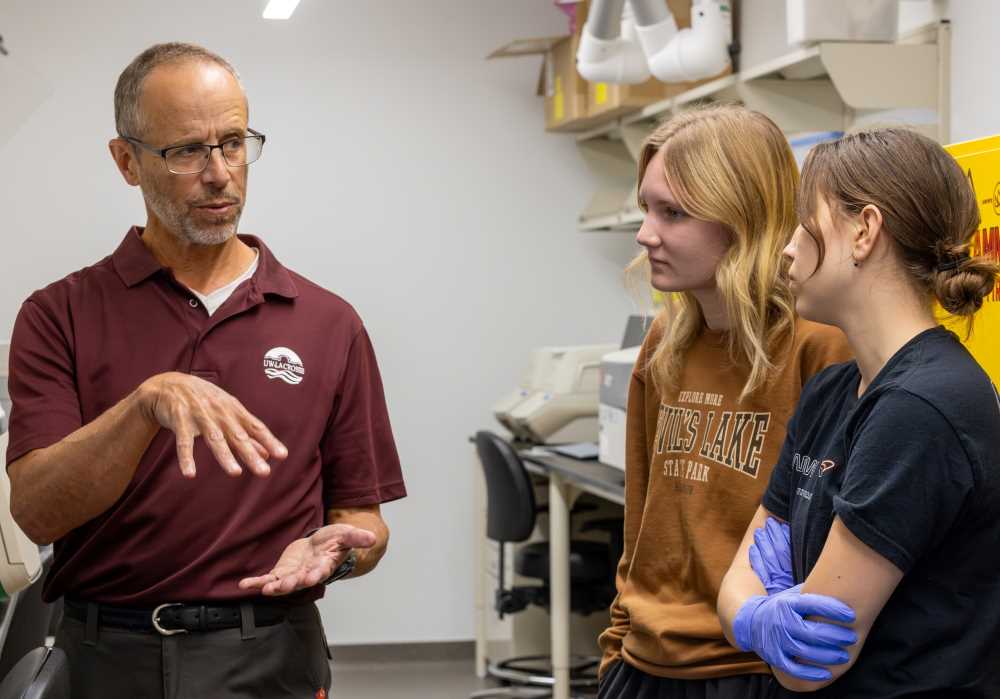
For the past 20 years, UWL Biology Professor Scott Cooper has transformed his Molecular Biology Lab into something that looks less like a traditional classroom and more like a small biotechnology company. In his course, students conduct real research for faculty “clients,” producing results that contribute to ongoing scholarly work across campus.
This past semester, students analyzed DNA extracted from the intestinal tissue of mice, examining a gene previously linked to stress. The work required advanced molecular biology techniques and demanded careful attention to detail — exactly the kind of experience students can expect in professional research settings.
For many students, doing real research in class was both nerve-wracking and affirming of their future plans.
“I wasn’t sure what a biochemistry major would look like in the real world,” says Gaden Geiser, a UWL senior majoring in biochemistry. “This embedded research coursework is reaffirming that this is what biochemists do — and that I really do like the major. I like working on something that might be the first time anyone has studied it. It makes the work feel more meaningful.”
Real research, real accountability
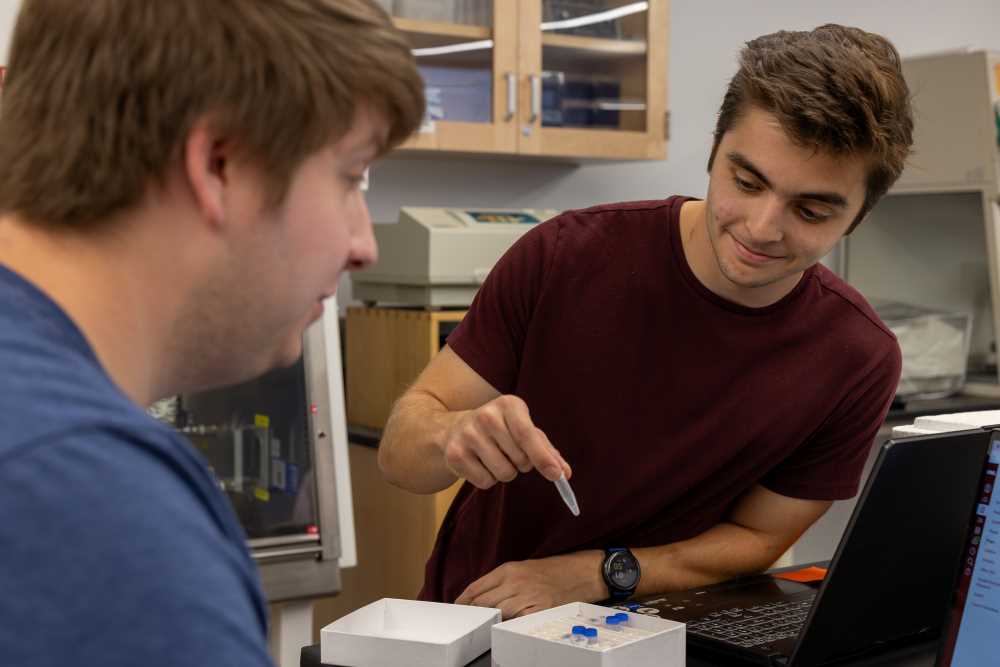
UWL was an early adopter of course-embedded research in the sciences. Cooper began integrating this approach into his courses in 2006, intentionally connecting students with campus researchers whose work could benefit from their findings. By the end of the semester, students complete the experience by writing a peer-reviewed journal article and submitting detailed lab notebooks and research products to their faculty clients.
This past fall, UWL Biology faculty members Sumei Liu and Jaspreet Kaur served as clients, engaging students in their ongoing research on gut stress and DNA barcoding of fungi, respectively. Since the program began, dozens of UWL faculty members from Biology, Microbiology, Chemistry & Biochemistry, and Exercise and Sport Science have partnered with Cooper’s course.
“Course-embedded research opportunities allow students to experience or practice real-life science, and this applies to all science careers,” says Todd Weaver, a professor of Chemistry & Biochemistry who was one of Cooper’s first clients. “Students learn how to collaborate and interpret results to design next steps during hands-on lab experiences ... Scott was way ahead of the field when it comes to course-embedded research. He may have developed one of the very first successful programs here at UWL.”
UWL’s expertise in course-embedded research has also gained national attention. Through the Council on Undergraduate Research, Cooper served as a consultant for a project helping two universities in North Carolina integrate research more fully into their curricula — an effort modeled largely on the UWL approach.
“This teaching technique uses class resources to help faculty members with research projects, instead of throwing everything out at the end of the semester,” Cooper says. “And students gain a sense of professionalism because they know their results will be used in future studies.”
That sense of accountability is felt strongly by students in the lab. Unlike traditional coursework, there is no step-by-step guide and no guarantee the experiments will work. Students must troubleshoot problems, interpret ambiguous results and adapt their methods — just as professional scientists do.
“We are the first people to study this topic in this specific way,” says Maria Benz, a UWL senior and biochemistry major who took Cooper’s course fall semester. “We’re not just following a protocol. We’re figuring things out as we go.”
Preparing for future careers
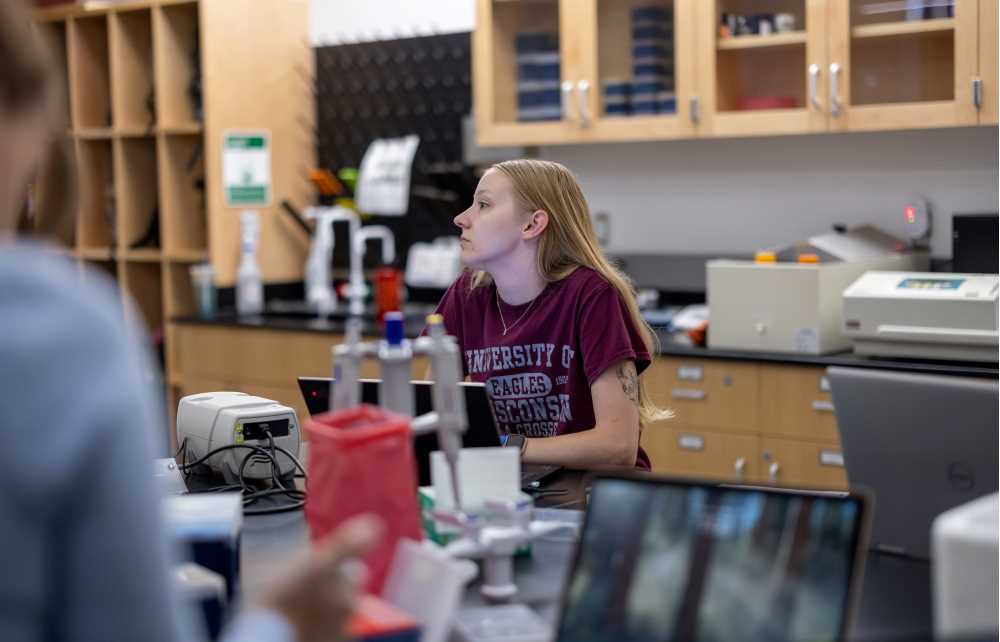
For Benz, the motivation to take this class is linked to her future career. Growing up, she helped care for her brother, who has Angelman syndrome, a rare genetic disorder that affects development, speech and motor skills.
“Helping with medications and learning about his condition pushed me toward the medical field,” she says.
As she prepares for medical school and the Medical College Admission Test, Benz says hands-on experience with techniques like quantitative polymerase chain reaction (qPCR) is important.
“I am able to understand how these techniques actually work,” she says.
That hands-on exposure is a key outcome of course-embedded research, Cooper says. By integrating research directly into required coursework, more students gain access to authentic research experiences — especially those who may not have the time or financial flexibility to pursue independent research outside of class.
Coming up with novel answers to unanswered questions requires extra effort, says Matthias Murphy, a senior in the class who is majoring in biochemistry and chemistry.
After graduation, Murphy plans to attend graduate school and eventually work in the biotechnology industry. He expects the labs he encounters in the future to resemble Cooper’s classroom, providing him early exposure.
A model with campus-wide impact
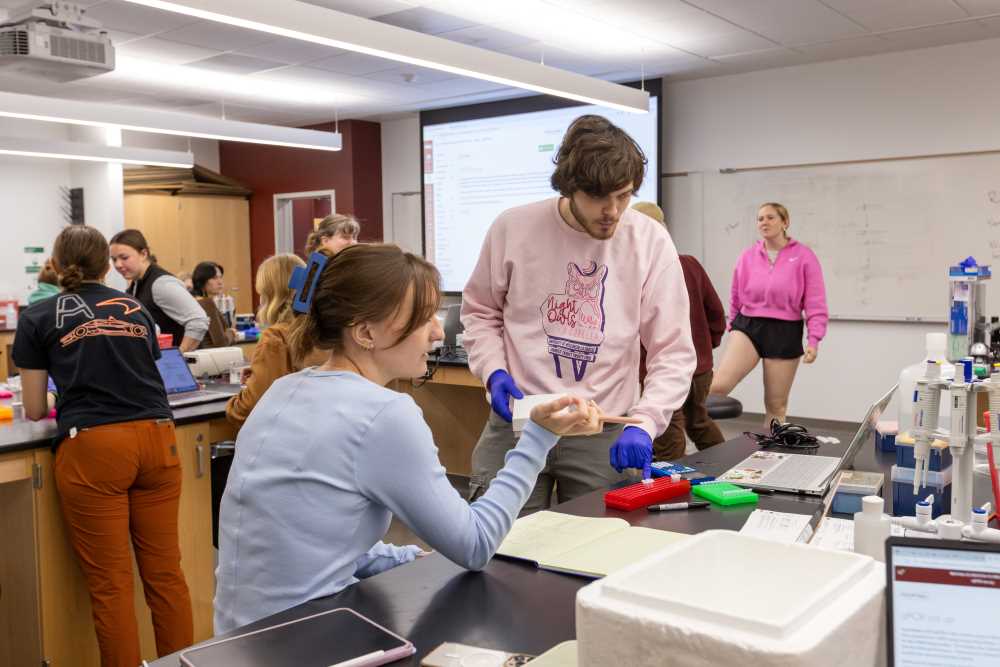
The influence of Cooper’s course extends well beyond a single semester or classroom. Some of his earliest faculty collaborators continue to see lasting effects on their research and teaching.
One of Cooper’s first clients was Weaver. His class project focused on creating specific amino acid changes in the enzyme fumarase, and his research group benefited by having a verified sample prepared that they could immediately use that same semester, he says. Today, students in Weaver’s biochemistry lab design their own mutations and present their findings at an annual poster session — a practice rooted in that early collaboration.
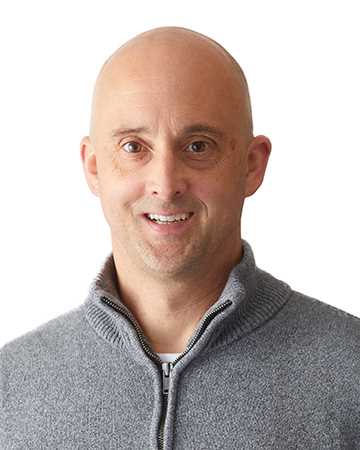
“I was a new faculty member and saw Scott's class as an opportunity to broaden the scope of my research program,” he explains.
Cooper intentionally partners with newer faculty members to help jump-start their research programs. One such collaborator is Jackie (Porath) Wisinski, a former student of Weaver’s who joined UWL’s faculty as an associate professor of biology in 2017.
Wisinski recalls experiencing some of the same challenges current students face when she was a student in Cooper’s course — working on novel questions and troubleshooting experiments that did not succeed on the first attempt. That process, she says, builds resilience.
“Course-embedded research — especially the client-based model that Scott has been using — changes the lab/classroom dynamic,” Wisinski says. “Students and the instructor are on the same team working toward a shared product for the client. This simulates a workplace.”
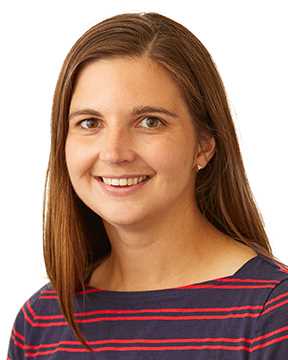
As a faculty member, Wisinski partnered with Cooper’s course during her first year on campus and will do so again this spring. In her first collaboration, students used CRISPR gene-editing techniques to create mutations in a protein she studies. Those modified cell lines are still being used in her research lab today.
“It’s easy to feel overwhelmed as a new faculty member,” Wisinski says. “Being the client meant I could provide background information and an experimental idea, and Scott helped with the execution. The support of a more senior colleague helped me build confidence in my research program and in my abilities as a mentor.”
For Cooper, one of the strengths of the model is the opportunity it creates for faculty collaboration and discovery. Each semester brings a new research question, new techniques and a wide range of final products. The challenge, he says, is that the syllabus evolves every term, and guiding 20 to 24 students through a complex, real-world research project requires significant organization and flexibility.
“But overall, it’s been very rewarding — and worth the extra effort,” Cooper says.
Course-embedded research aligns with the Driftless Experience and Elevating Excellence through Educational Innovation pillars within the new UWL Strategic Plan, says Weaver. Wisinski says the approach is poised to grow.
“Scott is truly an early adopter of course-embedded research,” she says. “I foresee more courses and instructors using this approach to give students diverse research experiences while also enhancing faculty research productivity.”